If you contribute to the National Pension System (NPS) through your bank branch, relationship manager, or fintech distributor, your retirement math changed on October 1, 2026.
The Pension Fund Regulatory and Development Authority (PFRDA) implemented a revised fee framework governing Points of Presence (PoPs)—the registered banks and intermediaries managing citizen onboarding and account maintenance. While the headline fee sounds negligible at just fractions of a percent, the long-term impact on compounding wealth tells a very different story.
Understanding the real impact of nps charges from october 2026 is essential for every Tier-I and Tier-II subscriber. Over a 25- to 30-year accumulation phase, small asset-under-management (AUM) fees quietly siphon off substantial sums from your final pension nest egg.
Here is an analysis of the new October 2026 PoP fee structure, the compounding drag it introduces, and the exact digital routes you can use to contribute at zero intermediary cost.
1. The October 2026 Regulatory Shift: What Changed?
Historically, NPS has been recognized as one of the lowest-cost pension vehicles globally. Fund Management Charges (FMC) charged by Pension Fund Managers (PFMs) sit below 0.09% per annum. However, to incentivize commercial banks and retail financial distributors to promote NPS actively, PFRDA revised the compensation structure for registered PoPs.
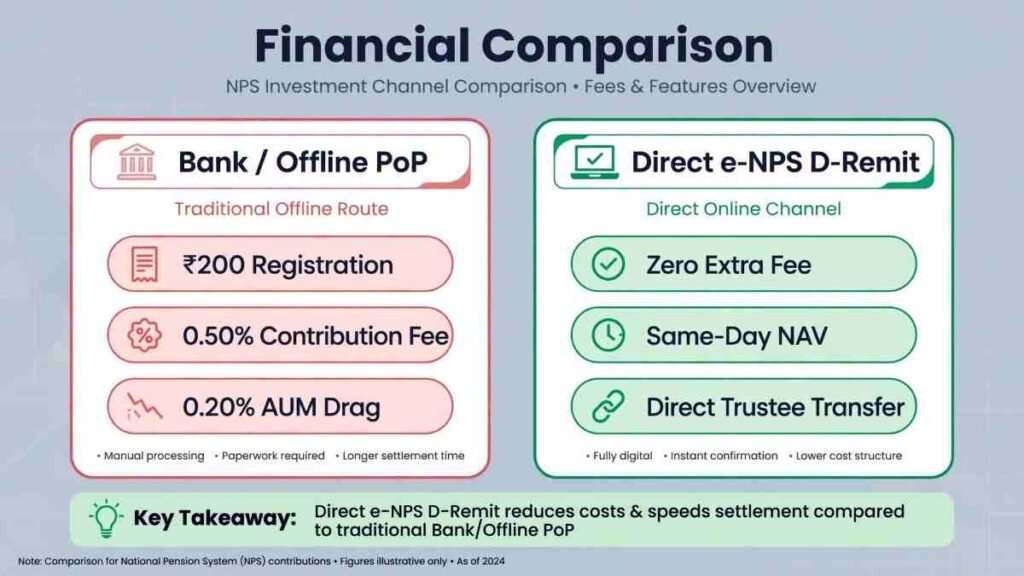
Add an infographic comparing Channel A (Bank PoP Fees) vs Channel B (Direct e-NPS D-Remit) here]
The Key Changes from October 1, 2026:
One-Time Digital/Physical Onboarding: A revised standard fee of ₹200 (or up to 0.10%–0.15% depending on channel verification requirements) levied per Permanent Retirement Account Number (PRAN).
Ongoing Contribution Commission: 0.50% of the contribution amount (subject to a minimum of ₹30 and a maximum cap of ₹25,000 per transaction) for cash, cheque, or manual bank-assisted contributions.
Annual Servicing AUM Fee: A recurring charge of up to 0.20% per annum on the total asset balance, deducted by redeeming units quarterly from non-dormant accounts managed under the PoP umbrella.
For a new subscriber, ₹200 or 0.20% appears trivial. But unlike health or car insurance, retirement investments run for three to four decades. In the world of exponential compounding, ongoing percentage-based AUM fees bite deeper as your account balance scales into seven and eight figures.
To calculate how small changes in fees alter long-term compounding across multi-decade timelines, run your contributions through the CalcNest SIP Calculator.
2. Breakdown: Direct e-NPS vs Offline / Bank PoP Route
The most critical factor to determine is your PRAN origin tag. Every NPS account is attached to a registered entity code:
If you opened your NPS at a public or private bank branch (such as SBI, HDFC, ICICI, or Axis), that financial institution acts as your designated Point of Presence (PoP).
If you opened your account via the central e-NPS CRA portal (Protean/NSDL or KFintech) without selecting an intermediary, your account operates as a Direct e-NPS account.
Feature / Charge Component
Offline Bank / Intermediary PoP
Direct e-NPS + D-Remit Pipeline
Registration / Onboarding Fee
Up to ₹200–₹400
Minimal CRA generation charge
Contribution Processing Charge
0.50% (Min ₹30, Max ₹25,000)
₹0 (Nil via Virtual Account UPI)
Annual AUM Servicing Fee
Up to 0.20% of Portfolio/Year
NIL (Zero PoP AUM trail fee)
Payment Gateway Surcharges
Standard Gateway / Debit Fee
₹0 (Via standard NEFT/RTGS/UPI)
NAV Allotment Timing
T+1 to T+2 Business Days
Same-Day NAV (cutoff before 9:30 AM)
When your PRAN carries an active PoP tag, the Central Recordkeeping Agency (CRA) periodically executes an automated redemption of units from your Tier-I or Tier-II holdings to settle servicing invoices sent by that intermediary.
3. The 30-Year Compounding Math: How 0.20% Destroys Capital
To appreciate why retail investors should avoid unearned AUM commissions, examine the cold mathematics of compounding drag.
The Real-World Profile:
Monthly Contribution: ₹10,000 (₹1,20,000 per year)
Investment Horizon: 30 Years
Gross Portfolio Return: 10.50% annualized (blended across equity Scheme E, corporate debt Scheme C, and government bonds Scheme G)
Total Out-of-Pocket Capital Invested: ₹36,00,000
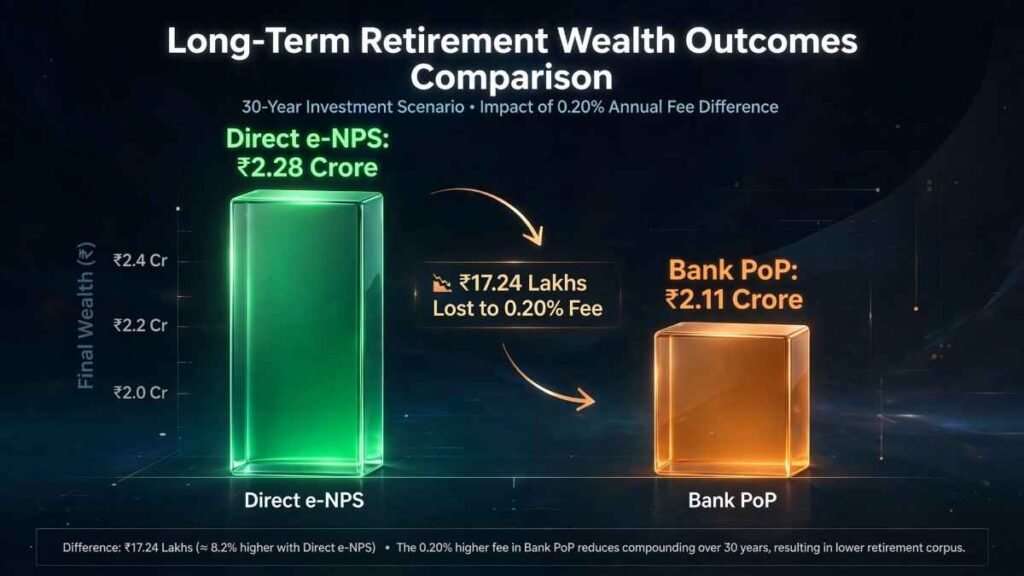
Add a comparison bar chart showing ₹2.28 Crore vs ₹2.11 Crore final corpus here]
Comparative Compounding Outcomes:
Channel A: Direct Route (Net Return: ~10.41% after standard FMC)
Final Corpus at Age 60:₹2,28,42,000 (Approx. ₹2.28 Crore)
Channel B: Bank PoP Route (Deducting 0.20% Annual Servicing AUM Fee)
Effective Return: ~10.21%
Final Corpus at Age 60:₹2,11,18,000 (Approx. ₹2.11 Crore)
The Real-World Loss
The 0.20% fee does not merely consume 0.20% of your gains. Over 30 years, it produces a deadweight loss of ₹17,24,000 (Over 17 Lakhs).
Those deducted units can no longer participate in bull-market cycles. You forfeit not only the fee paid to the bank, but the compounding gains those missing units would have generated across the subsequent two decades.
To project how tax savings, employer contributions, and net liabilities align under Indian tax laws, review our detailed guide on the CalcNest Income Tax Calculator.
4. The Zero-Fee Shield: Setting Up D-Remit (Virtual Account Number)
You do not need to surrender your PRAN or pause contributions to escape high intermediary fees. PFRDA provides an automated direct-clearing channel: Direct Remittance (D-Remit).
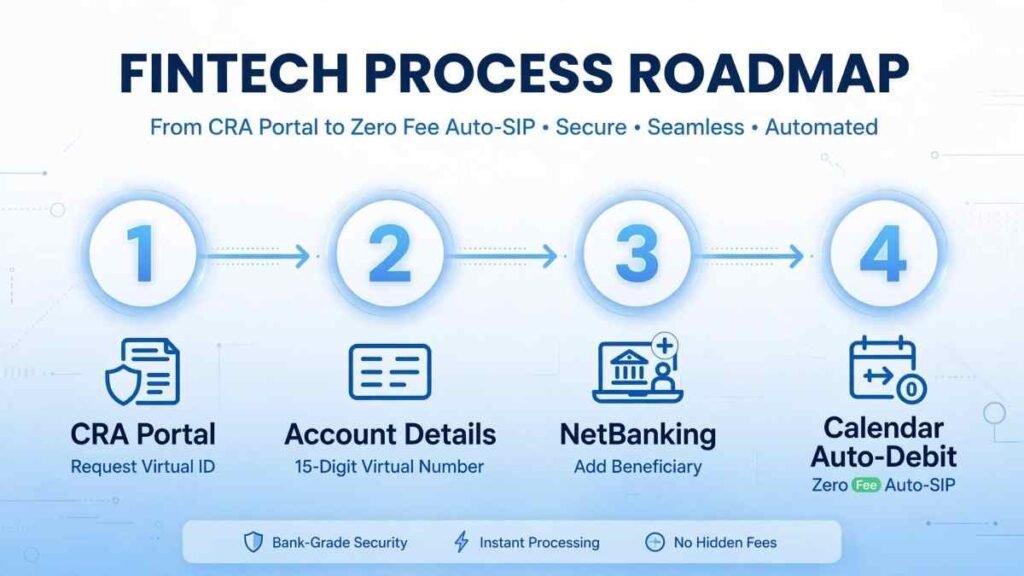
Add a 4-step roadmap graphic on how to activate D-Remit here]
Why D-Remit Is Superior:
0% Intermediary Fee: D-Remit deposits move directly from your bank account to the Trustee Bank (Axis Bank) without routing through payment gateways or retail intermediary desks.
Zero Gateway Surcharges: Credit card or net-banking gateway fees (which range from ₹0.80 to 0.75% + GST) are completely bypassed.
Same-Day NAV Allotment: If funds reach the Trustee Bank via NEFT/RTGS/IMPS before 9:30 AM on any working business day, you receive that exact day’s closing Net Asset Value (NAV).
5. Step-by-Step: How to Activate D-Remit in 5 Minutes
Setting up your D-Remit virtual account is straightforward:
Step
Action Required
Step 1: Visit CRA Portal
Access Protean (CRA-NSDL) or KFintech e-NPS portal
Step 2: Request Virtual ID
Input 12-digit PRAN, Date of Birth, and verify via OTP
Step 3: Receive Virtual Account
Get your unique 15-digit Virtual Account Number & IFSC
Step 4: Add Beneficiary
Add Trustee Bank as a beneficiary in your standard NetBanking
Step 5: Set Auto-Debit
Schedule a monthly auto-transfer right after your salary date
Step 1: Request Virtual Account ID
Go to your respective CRA portal (Protean or KFintech) and select “Virtual ID (D-Remit) Creation”. Enter your 12-digit PRAN, date of birth, and verify the transaction via mobile OTP.
Step 2: Note Account & IFSC Details
Within minutes, you receive an automated confirmation containing an account configuration structured like:
Account Name: NPS Tier I / Your Registered Legal Name
Virtual Account Number: 15 digits (typically beginning with 6001... or 6002... followed by your PRAN digits)
Account Type: Current Account
Bank Name & IFSC: Axis Bank, Trustee Bank Branch (UTIB0CCH274)
Step 3: Add to Your Bank’s NetBanking
Log in to your standard banking portal (HDFC, SBI, ICICI, etc.), go to Add Inter-Bank Beneficiary (NEFT/RTGS), and add your new virtual account details.
Step 4: Automate Your Monthly Transfer
Once the beneficiary cooling period passes, set an automated Standing Instruction (SI) for your target amount (e.g., ₹5,000 or ₹10,000) dated 2 days after your monthly salary credit.
Your retirement contributions will process uninterrupted at zero processing cost, with zero gateway fees, zero intermediary commissions, and consistent same-day NAV execution.
6. How to Delink an Existing Bank PoP from Your PRAN
If your PRAN is already tagged to a bank branch, you are not permanently tied to their fee structure.
Submit an Inter-Sector Shifting (ISS) Request: Log in to your central CRA dashboard with your PRAN credentials.
Shift to Direct e-NPS / Direct Citizen Sector: Under the “Demographic Changes” or “Service Requests” menu, choose the option to transfer your PRAN away from your bank’s PoP registration code to the generic e-NPS / Direct Citizen pool.
Confirm with e-Sign (Aadhaar OTP): Authorize the shifting form digitally. Once processed, the bank loses the regulatory authority to bill your account for quarterly AUM servicing fees.
To determine how to balance retirement allocations against your real estate debt payoff, review our comprehensive breakdown on the CalcNest Loan EMI Calculator.
Summary Checklist: Maximize Your Pension in 2026
Avoid (High Leakage)
Adopt (Maximum Wealth)
Cash or cheque deposits at local bank branches
Direct electronic contributions via D-Remit
Payment gateway credit card checkouts
Standing instruction NEFT direct transfers
Allowing an inactive bank PoP to collect annual AUM fees
Delinking PoPs to become an independent Direct Citizen
Overlooking quarterly unit cancellation debits
Periodically reviewing CRA Transaction Statements
Take Control of Your Retirement Compounding
The revised nps charges from october 2026 highlight a fundamental truth in personal finance: every basis point matters. A 0.20% ongoing fee may appear harmless on paper, but left unchecked over your working career, it costs you hundreds of thousands—or even millions—of rupees.
Delinking intermediaries and automating deposits via direct D-Remit virtual accounts ensures every earned rupee remains invested in your equity and debt indices, working entirely for your financial future.
What is your setup? Have you checked your latest CRA statement for unexpected unit deductions under PoP servicing fees?
Share your questions and experiences in the comments below! To model your long-term returns, retirement milestones, and loan schedules with precision, explore the full suite of interactive tools on the CalcNest Homepage.