
Meta Description: Confused between the Old and New Tax Regimes in India? Read our ultimate 2026 tax planning guide comparing tax slabs, deductions (80C, 80D, HRA), and expert strategies to maximize your savings.

Tax planning is one of the most critical financial exercises for every earning individual in India. Every financial year, salaried professionals and business owners face a major dilemma: Should I stick with the Old Tax Regime or switch to the New Tax Regime?
With regular updates in tax slabs and exemption limits, choosing the wrong regime can cost you thousands—if not lakhs—of rupees in extra taxes. In this comprehensive guide, we will break down both tax structures, analyze popular deductions, compare slab rates, and help you determine which regime puts more money back into your pocket.
Understanding the Two Tax Regimes in India
Before calculating which option saves more money, let’s understand how each regime operates under the Indian Income Tax framework.

1. The Old Tax Regime: The Traditional Deduction-Based Model
The Old Tax Regime has been around for decades. Its core philosophy is simple: the government encourages you to save and invest for your future (like insurance, provident funds, housing loans) by offering tax deductions.
- Key Feature: It allows more than 70 tax deductions and exemptions, including the famous Section 80C, 80D (health insurance), House Rent Allowance (HRA), Leave Travel Concession (LTC), and home loan interest under Section 24.
- Who it suits best: Individuals who have significant financial investments, active home loans, high rental expenses, and standard family medical insurances.
Quick Financial Planning Tool: To calculate your exact take-home salary and tax liabilities under both regimes, use our interactive CalcNest Income Tax Calculator for precise calculations.
2. The New Tax Regime: The Simplified Low-Slab Model
Introduced to simplify tax filing, the New Tax Regime offers lower tax slab rates across various income brackets, but it comes with a major catch: you must let go of almost all major deductions and exemptions (such as 80C, 80D, and HRA).
- Key Feature: Lower tax rates with a wider income slab structure. It is now considered the default tax regime unless you explicitly opt for the old one while filing your returns.
- Who it suits best: Freshers, young professionals, or individuals who do not want to lock their money in tax-saving instruments and prefer higher disposable cash in hand.
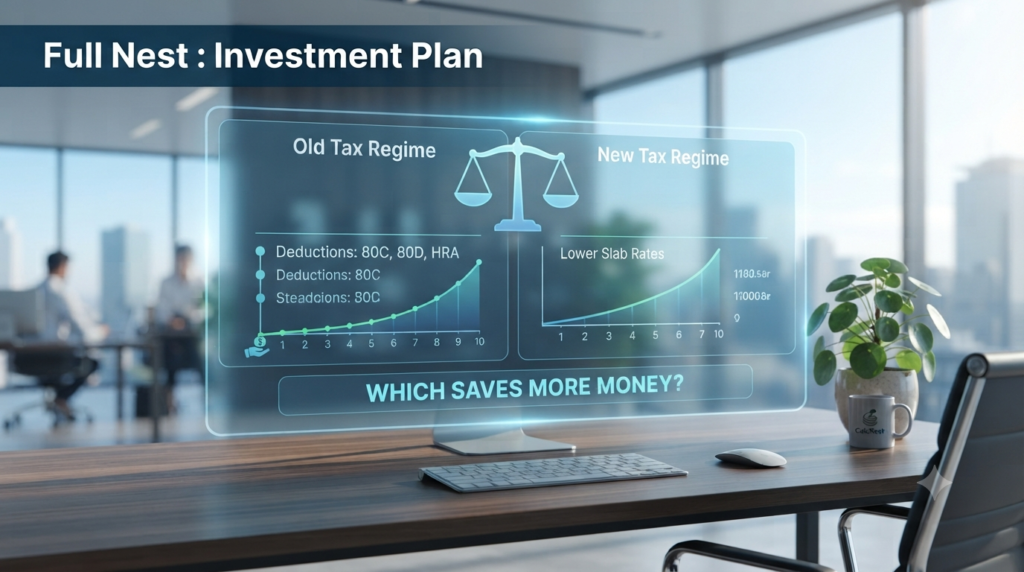
Detailed Slab-by-Slab Comparison
To understand how your tax is calculated, let’s look at the income tax slab structures under both regimes for individual taxpayers:
| Income Slab (INR) | Old Tax Regime Rates | New Tax Regime Rates |
| Up to ₹3,00,000 | Nil | Nil |
| ₹3,00,000 – ₹6,00,000 | 5% | 5% |
| ₹6,00,000 – ₹9,00,000 | 20% | 10% |
| ₹9,00,000 – ₹12,00,000 | 20% | 15% |
| ₹12,00,000 – ₹15,00,000 | 30% | 20% |
| Above ₹15,00,000 | 30% | 30% |
(Note: Rebates under Section 87A can further reduce tax liability for incomes up to specific thresholds as per current Union Budget rules.)
Key Deductions Available ONLY Under the Old Tax Regime
If you choose the Old Tax Regime, you can leverage several exemptions to bring your taxable income down drastically. Here are the most powerful deductions:
- Section 80C: Allows deductions up to ₹1.5 Lakhs per financial year through investments in Public Provident Fund (PPF), Employee Provident Fund (EPF), Equity-Linked Savings Schemes (ELSS), Life Insurance premiums, and tuition fees. To understand safe market-linked tax savers like ELSS, you can refer to guidelines by the Securities and Exchange Board of India (SEBI).
- Section 80D: Deductions for health insurance premiums paid for yourself, your family, and dependent parents (ranging from ₹25,000 to ₹50,000+).
- HRA (House Rent Allowance): If you live in a rented house and receive HRA as part of your salary structure, a substantial portion can be claimed tax-free.
- Section 24 (Home Loan Interest): Deduction of up to ₹2 Lakhs on the interest component of a housing loan for a self-occupied property.
To stay updated with official notifications, income tax slab updates, and filing procedures, you can check the official portal of the Income Tax Department, Government of India.
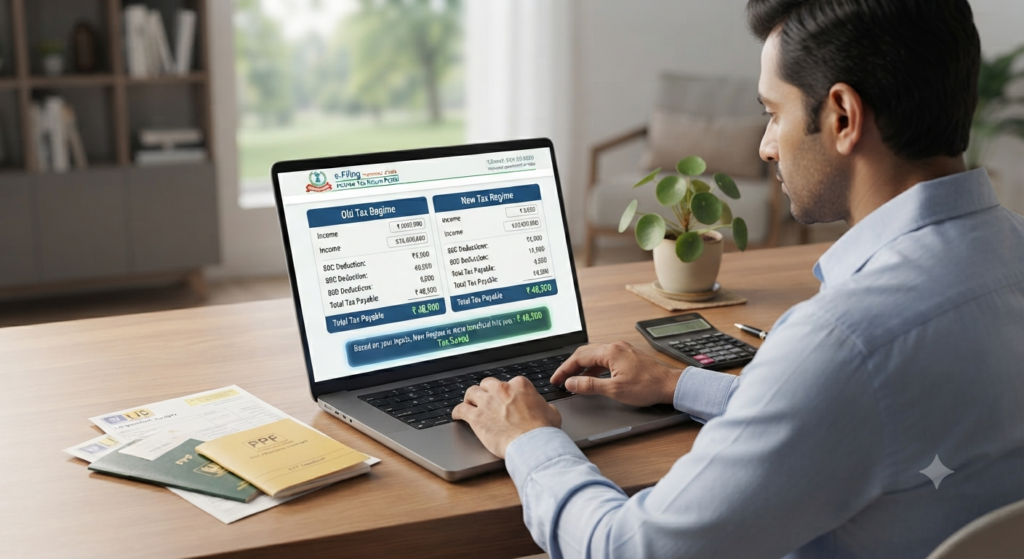
Which Regime Saves More Money? (Case Study Approach)
The short answer is: It depends entirely on your total deductions.
- When Old Regime Wins: If your total eligible deductions (80C + 80D + HRA + Home Loan Interest) exceed ₹1.5 Lakhs to ₹2.5 Lakhs (depending on your total income bracket), the Old Tax Regime will almost always save you more money by lowering your net taxable income.
- When New Regime Wins: If you do not have a home loan, do not claim high HRA, and prefer not to lock money into 80C instruments, the lower tax rates of the New Tax Regime make it a clear winner.
To plan your long-term wealth alongside tax saving, feel free to visit our main CalcNest Home Page and explore our specialized financial utility tools.
Frequently Asked Questions (People Also Ask)
Q1. Can I switch between the Old and New Tax Regimes every year?
Ans: Yes! Salaried individuals have the flexibility to choose between the Old and New Tax Regimes every financial year at the time of submitting investment proofs to their employer or while filing their Income Tax Return (ITR). However, individuals with business or professional income have restricted switching options.
Q2. Is the Standard Deduction available in both regimes?
Ans: Yes, the standard deduction is available under both the Old and New Tax Regimes, providing flat relief to salaried employees and pensioners.
Q3. Which regime is better for someone earning ₹10 Lakhs a year?
Ans: If you can claim deductions totaling more than ₹2.5 Lakhs (via 80C, HRA, health insurance, etc.), the Old Regime will save you more. If your total deductions are minimal, the New Regime’s lower slab rates will result in less tax liability.
Q4. Are investments like ELSS or PPF useful under the New Tax Regime?
Ans: While they will not give you tax deductions under the New Tax Regime, ELSS and PPF remain stellar wealth-creation and asset-building tools for long-term financial goals.
Disclaimer
Disclaimer: The information provided in this article is for general informational and educational purposes only and does not constitute professional tax or legal advice. Tax laws, slabs, and rebates are subject to change based on Union Budget announcements and government regulations. Always consult a qualified Chartered Accountant (CA) or tax professional before filing your taxes.