
Meta Description: Confused about GST inclusive and exclusive calculations? Learn the exact formulas, step-by-step examples, and expert tips to compute Goods & Services Tax accurately for your business or invoices.
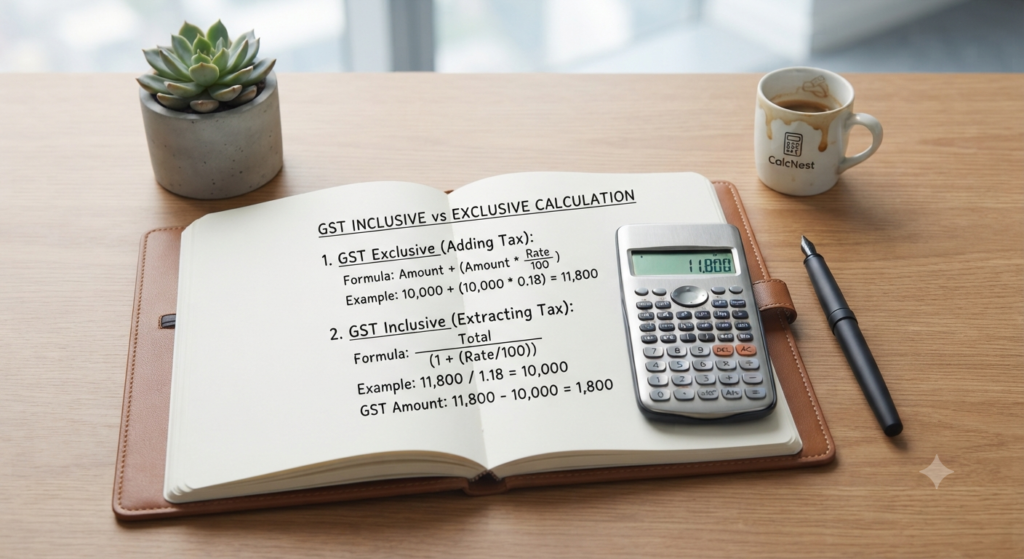
Goods and Services Tax (GST) has transformed the indirect taxation landscape across India and multiple global economies. Whether you are a business owner pricing your products, a freelancer generating invoices, or a consumer checking retail bills, understanding how GST works is essential.
One of the most common confusions people face is distinguishing between GST Exclusive and GST Inclusive pricing. Calculating them incorrectly can lead to undercharging clients or misreporting taxes. In this comprehensive guide, we will break down the formulas, provide clear examples, and show you how to compute both seamlessly.
What is GST Exclusive vs GST Inclusive?
Before diving into formulas, let’s establish the fundamental difference between the two terms:
- GST Exclusive Price: This is the base price of a product or service before the tax is added. When you go to check out or generate an invoice, the applicable GST rate is calculated on this base price and added to the total payable amount.
- GST Inclusive Price: This is the final lump-sum price that already includes the tax component. The buyer pays this total amount, and the seller later bifurcates it into the base price and the tax liability to deposit with the government.
Quick Financial Tool: To handle complex tax mathematics and quick computations without manual errors, you can use our dedicated business tools on the CalcNest Home Page.
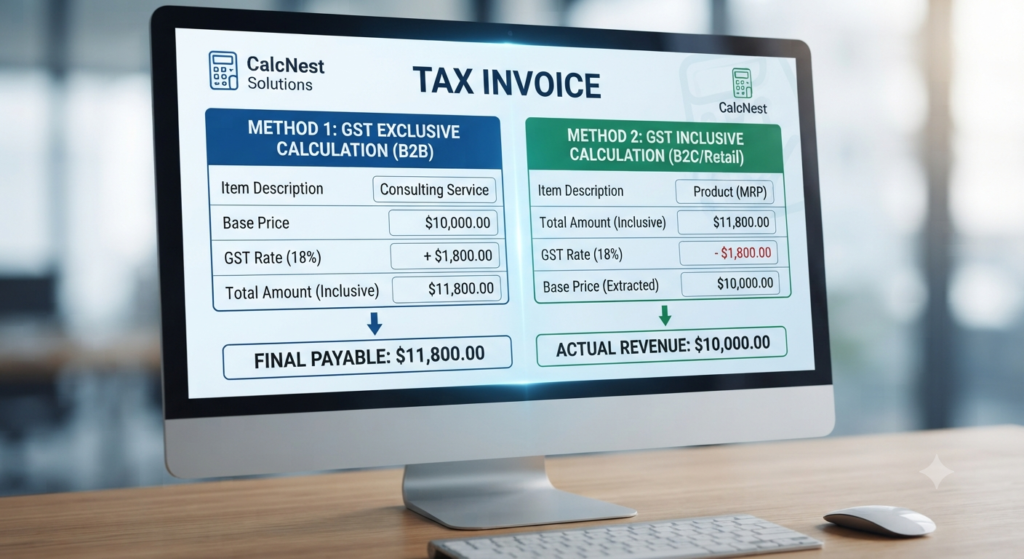
1. GST Exclusive Calculation (Adding Tax to Base Price)
When you have a base price and need to add GST to find out how much the customer needs to pay, you use the GST Exclusive Formula. This is standard practice in B2B (Business-to-Business) transactions and wholesale pricing.
The Formula:
GST Amount=Base Price×(100GST Rate)
Total Price (Inclusive)=Base Price+GST Amount
Alternatively, you can calculate it in one direct step:
Total Price=Base Price×(1+100GST Rate)
Step-by-Step Example:
- Base Price: ₹10,000
- GST Rate: 18%
- Calculate GST Amount:₹10,000×(10018)=₹1,800
- Calculate Total Price:₹10,000+₹1,800=₹11,800
Thus, the final invoice value will be ₹11,800, where ₹1,800 goes toward Goods and Services Tax. To stay updated with official tax codes, rates, and compliance rules in India, you can check the official portal of the Central Board of Indirect Taxes and Customs (CBIC).
2. GST Inclusive Calculation (Extracting Tax from Total Price)
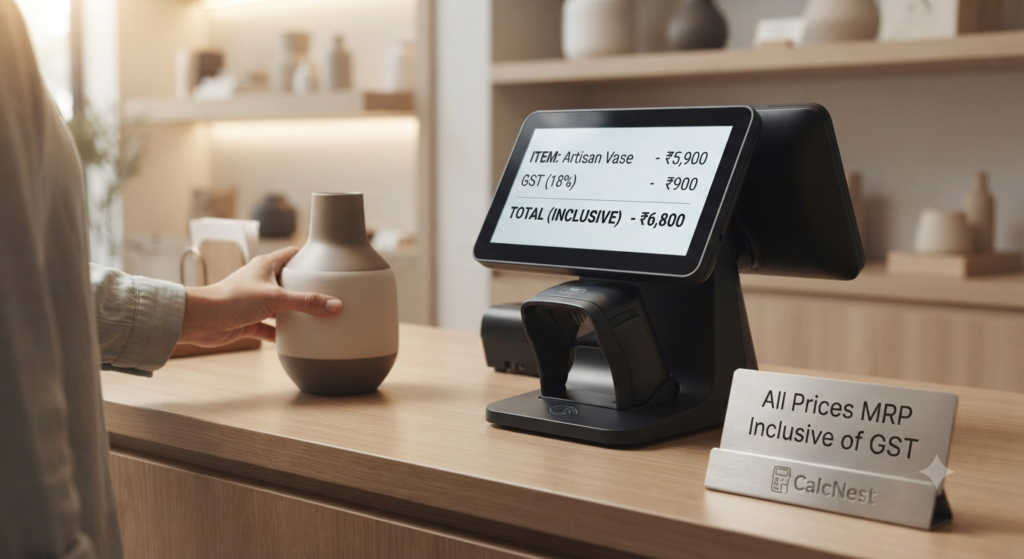
When you run a retail business (B2C) or deal with MRP (Maximum Retail Price) tags, the price displayed to the customer is usually GST inclusive. If you need to separate the base cost from the tax component for accounting or return filing, you must use the GST Inclusive Formula.
The Formula:
GST Amount=Total Price−(1+(100GST Rate)Total Price)
Or simply to find the Original Base Price:
Base Price=1+(100GST Rate)Total Price
Step-by-Step Example:
- Total Inclusive Price (MRP): ₹11,800
- GST Rate: 18%
- Calculate Base Price:Base Price=1+0.1811,800=1.1811,800=₹10,000
- Calculate GST Amount:Total Price−Base Price=₹11,800−₹10,000=₹1,800
For comprehensive guidelines on financial reporting and accounting standards related to indirect taxes, you can refer to the resources provided by the Institute of Chartered Accountants of India (ICAI).
Comparison Table: Exclusive vs. Inclusive Calculations
| Parameter | GST Exclusive Calculation | GST Inclusive Calculation |
|---|---|---|
| Starting Point | Base Price (Without tax) | Total Price (With tax / MRP) |
| Objective | To find the final bill amount by adding tax | To extract the base price and tax component |
| Commonly Used In | B2B invoices, wholesale quotes, vendor pricing | B2C retail, retail billing, MRP product tags |
| Multiplication/Division Factor | Multiplied by (1+Rate/100) | Divided by (1+Rate/100) |
To explore more finance, tax, and investment calculators tailored for professionals, visit our main platform at CalcNest.
Frequently Asked Questions (People Also Ask)
Q1. Why does extracting GST from an inclusive price feel higher than applying it?
Ans: This happens due to the mathematical base change. When calculating exclusive tax, you multiply the smaller base price by the rate. When extracting from an inclusive price, the percentage is calculated backward from a larger aggregate total value, making the effective tax fraction appear different if applied directly.
Q2. Is GST charged on top of MRP in retail stores?
Ans: No. Under consumer protection and tax laws, the MRP printed on a product is strictly inclusive of all taxes, including GST. A retailer cannot charge extra over the printed MRP.
Q3. Which calculation method should I use for B2B invoices?
Ans: For B2B invoices, always use the GST Exclusive method. You list the base price of the goods or services, add CGST/SGST or IGST explicitly on top, and arrive at a grand total. This helps registered businesses claim Input Tax Credit (ITC) correctly.
Q4. Can online tax calculators automate these calculations?
Ans: Yes, using digital utility calculators eliminates human calculation errors, especially when dealing with complex multi-item invoices carrying different tax slabs (e.g., 5%, 12%, 18%, 28%).
Disclaimer
Disclaimer: The information provided in this article is for general informational and educational purposes only and does not constitute formal financial, accounting, or legal advice. Tax laws, compliance mandates, and filing procedures are subject to regular updates by regulatory bodies. Always consult a certified accountant or tax consultant for business-specific financial filings.