
Meta Description: Master your daily calorie intake for weight loss or muscle gain with expert formulas, TDEE calculations, and global health tips tailored for the US and India on CalcNest.
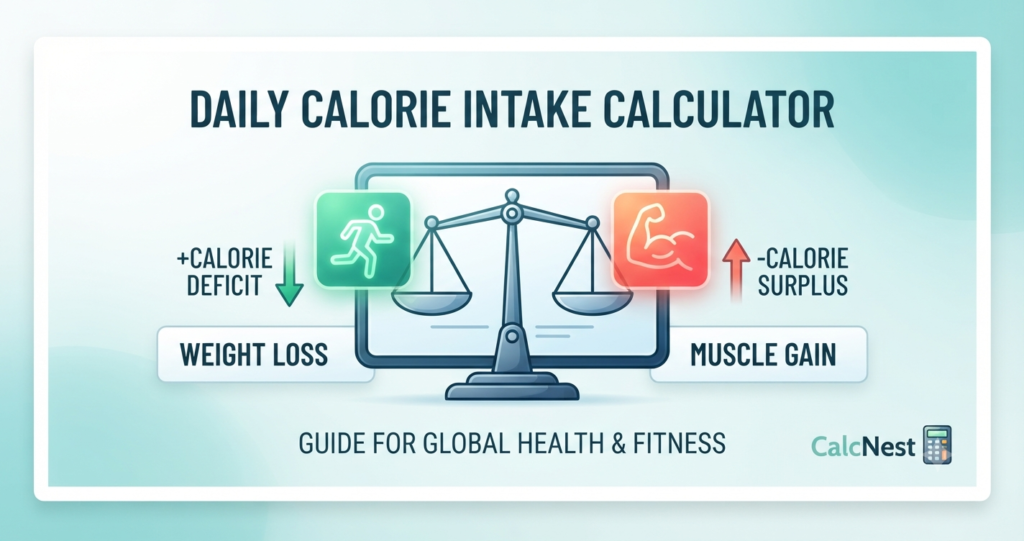
Understanding how many calories your body needs is the foundation of any successful fitness journey. Whether your goal is cutting body fat in the United States or bulking up cleanly with traditional and modern diets in India, tracking your energy balance is essential. At CalcNest, we simplify fitness and health computations for a worldwide audience. In this complete guide, you will learn how to calculate your maintenance calories, adjust them for fat loss or muscle building, and explore the top FAQ answers.
What is Daily Calorie Intake and TDEE?
Your Total Daily Energy Expenditure (TDEE) is the total number of calories your body burns in a day, including resting metabolism, daily activities, and exercise.
- Calorie Deficit (Weight Loss): Consuming fewer calories than your TDEE forces your body to use stored fat for energy.
- Calorie Surplus (Muscle Gain): Consuming more calories than your TDEE provides the extra energy required to build new muscle tissue.
1. How to Calculate Your Maintenance Calories (BMR + Activity Level)
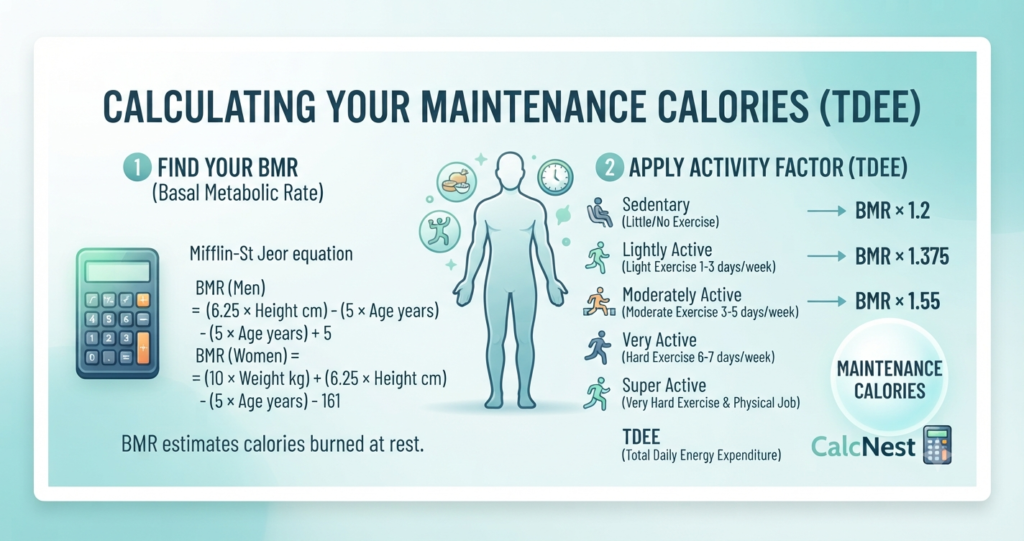
To determine your calorie target, you first need to find your Basal Metabolic Rate (BMR) using the Mifflin-St Jeor Equation:
$$\text{BMR (Men)} = (10 \times \text{Weight in kg}) + (6.25 \times \text{Height in cm}) – (5 \times \text{Age in years}) + 5$$
$$\text{BMR (Women)} = (10 \times \text{Weight in kg}) + (6.25 \times \text{Height in cm}) – (5 \times \text{Age in years}) – 161$$
Step-by-Step Activity Multipliers (TDEE):
- Sedentary (Little or no exercise): $\text{BMR} \times 1.2$
- Lightly Active (Light exercise/sports 1-3 days/week): $\text{BMR} \times 1.375$
- Moderately Active (Moderate exercise 3-5 days/week): $\text{BMR} \times 1.55$
- Very Active (Hard exercise 6-7 days/week): $\text{BMR} \times 1.725$
2. Adjusting Calories for Weight Loss vs. Muscle Gain
For Weight Loss (Fat Cutting):
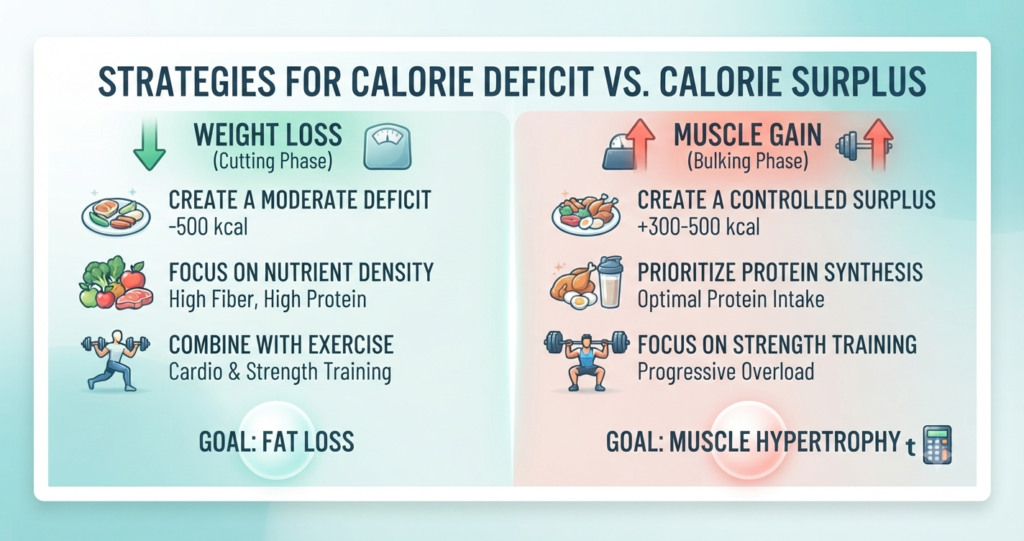
To lose about 0.5 kg to 1 kg per week safely, create a moderate deficit of 500 to 750 calories below your TDEE. For example, if your maintenance TDEE is 2,500 calories, your target weight-loss intake will be around 1,750 to 2,000 calories. To explore more health calculators, visit our tool hub at CalcNest All Calculators.
For Muscle Gain (Bulking):
To build muscle while minimizing fat accumulation, add a controlled surplus of 300 to 500 calories above your TDEE. Ensure your protein intake remains high (approx. 1.6 to 2.2 grams per kg of body weight).
Comparison Table: Weight Loss vs. Muscle Gain Strategy
| Parameter | Weight Loss (Cutting) | Muscle Gain (Bulking) |
| Caloric Goal | Calorie Deficit ($\text{TDEE} – 500\text{ kcal}$) | Calorie Surplus ($\text{TDEE} + 400\text{ kcal}$) |
| Primary Focus | Fat reduction while retaining lean mass | Muscle hypertrophy and strength building |
| Macronutrient Priority | High Protein & Fiber | High Protein & Complex Carbohydrates |
| Global Regional Context | Popular across US fitness and Indian urban wellness hubs | Essential for bodybuilders and athletes worldwide |
Frequently Asked Questions (Google “People Also Ask”)
Q1: How many calories should I eat a day to lose weight?
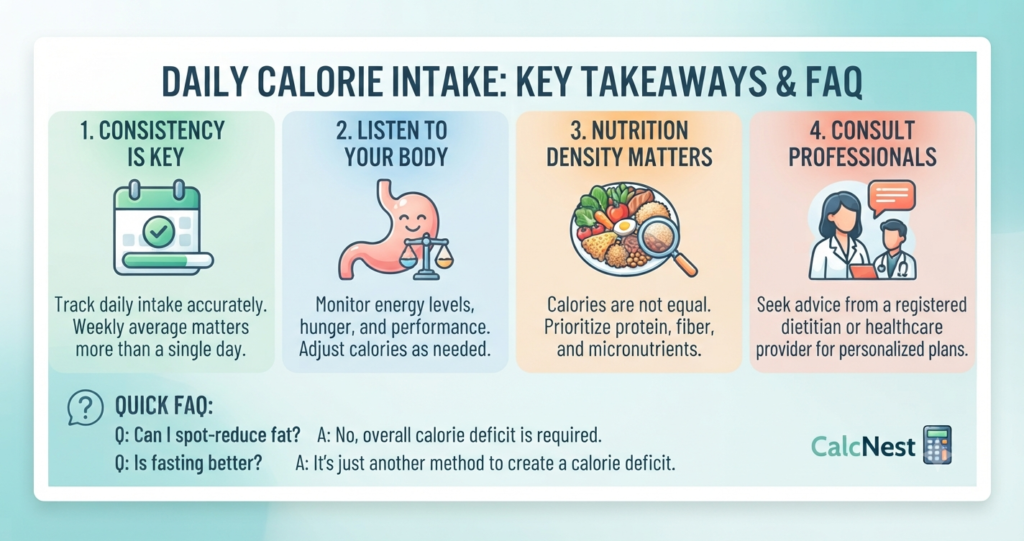
Ans: A safe and sustainable weight loss diet typically involves a deficit of 500 calories per day, which generally leads to a loss of about 0.5 kg per week.
Q2: Is it safe to drop below 1,200 calories a day?
Ans: Generally, no. Dropping below 1,200 calories for women or 1,500 calories for men without medical supervision can lead to nutrient deficiencies, fatigue, and a slowed metabolism.
Q3: How do I calculate my daily calorie intake manually?
Ans: First calculate your BMR using your weight, height, and age, then multiply that number by your activity factor to get your TDEE, and finally add or subtract calories based on your fitness goals.
Disclaimer
Disclaimer: The information provided in this article and on CalcNest is for general educational and informational purposes only. Always consult a certified nutritionist or healthcare professional before starting any drastic diet or fitness program.