
Meta Description: Learn how to calculate your body fat percentage using the proven US Navy formula. Get step-by-step instructions, formulas for men and women, and expert tips for accurate tracking on CalcNest.

When it comes to tracking physical health and fitness progress, relying solely on your bathroom weighing scale can be misleading. Weight alone does not distinguish between muscle mass, water weight, and stored body fat. Whether you are transforming your physique in fitness hubs across the United States or tracking your wellness goals internationally, measuring your actual body fat percentage provides a true reflection of health.
At CalcNest, our goal is to deliver precise, easy-to-use utility tools and human-written educational content designed to help you achieve your goals and secure platform approvals like Google AdSense. In this comprehensive guide, we will break down the scientifically validated US Navy Body Fat Formula, provide step-by-step calculation methods for both men and women, and answer the top Google “People Also Ask” questions.
What is Body Fat Percentage and Why Does It Matter?
Body fat percentage is the total mass of fat divided by your total body mass, multiplied by 100. Essential fat is necessary for maintaining life and reproductive functions, while stored fat protects internal organs.
Monitoring body fat rather than just body weight helps you understand:
- True Fitness Progression: You can lose fat while gaining muscle, which might keep your weight constant while dramatically improving your body composition.
- Health Risk Mitigation: Excess visceral fat is closely linked to metabolic syndromes, cardiovascular issues, and type 2 diabetes.
- Targeted Training: Knowing your baseline helps you design better cutting or bulking cycles.
While clinical methods like DEXA scans and hydrostatic weighing are highly accurate, they are expensive and often inaccessible. This is where the US Navy circumference method comes in—offering a reliable, cost-free alternative that you can perform at home using just a measuring tape.
The Science Behind the US Navy Body Fat Formula
Developed by researchers at the Naval Health Research Center, this formula estimates body fat percentage by measuring body circumferences and height. Because fat distribution differs biologically between genders, there are two distinct formulas—one for men and one for women.
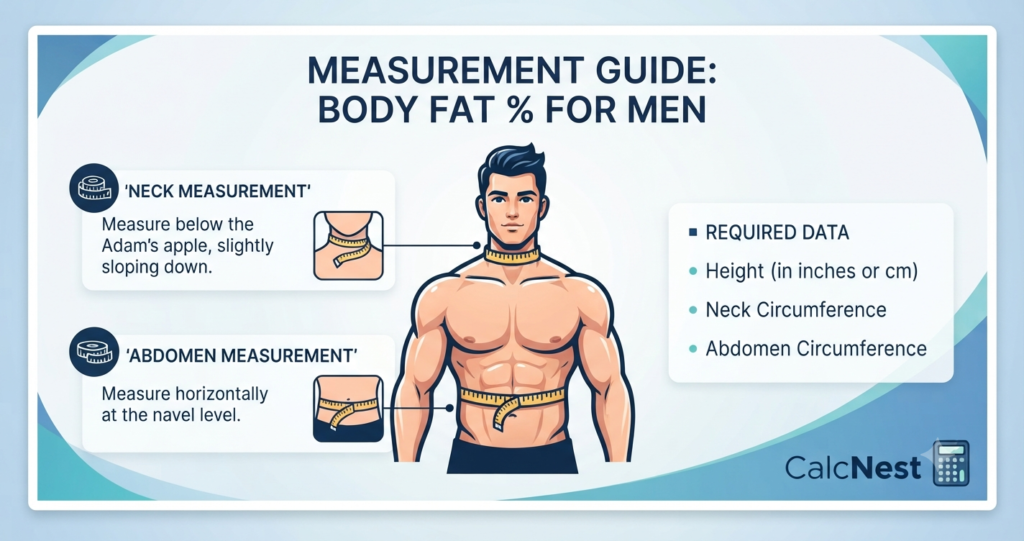
1. US Navy Body Fat Formula for Men
For men, the calculation requires measurements of the neck and abdomen (at the level of the navel), along with overall height.
$$\text{Body Fat } \% = 86.010 \times \log_{10}(\text{Abdomen} – \text{Neck}) – 70.041 \times \log_{10}(\text{Height}) + 36.76$$
Step-by-Step Measurement Guide for Men:
- Height: Measure your height barefoot while standing straight.
- Neck: Measure just below the larynx (Adam’s apple), with the tape sloping slightly downward to the front.
- Abdomen: Measure horizontally at the level of the navel (belly button). For individuals with looser skin or posture variations, ensure a horizontal level across the back.
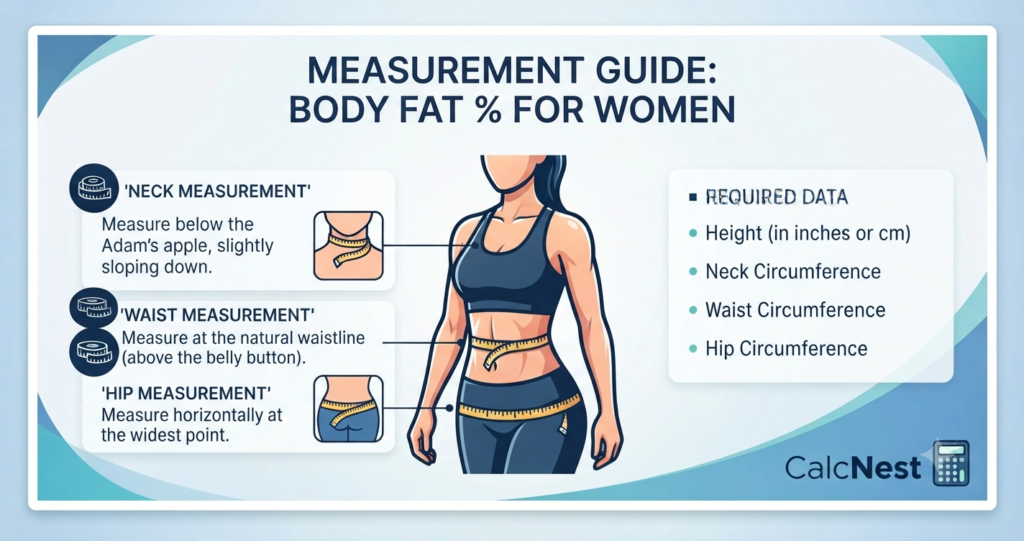
2. US Navy Body Fat Formula for Women
For women, the calculation requires measurements of the neck, waist (at the narrowest point), and hips (at the widest horizontal part of the hips or glutes), along with height.
$$\text{Body Fat } \% = 163.205 \times \log_{10}(\text{Waist} + \text{Hip} – \text{Neck}) – 97.684 \times \log_{10}(\text{Height}) – 78.387$$
Step-by-Step Measurement Guide for Women:
- Height: Measure your height barefoot while standing straight.
- Neck: Measure just below the larynx, keeping the tape horizontal.
- Waist: Measure at the point of maximum horizontal indentation (the narrowest part of the abdomen).
- Hips: Measure horizontally at the widest part of the hip/buttocks extension.
To perform instant calculations without manual math, you can check out our free utility tools available on the CalcNest Homepage.
Practical Example: Calculating Body Fat for Men
Let’s walk through a practical example to see how the US Navy formula works in real life:
- Gender: Male
- Height: 70 inches (approx. 178 cm)
- Neck Circumference: 15 inches (approx. 38 cm)
- Abdomen Circumference: 34 inches (approx. 86 cm)
Calculation Steps:
- Find the Difference (Abdomen – Neck): $34 – 15 = 19$
- Take the Logarithm ($\log_{10}$): $\log_{10}(19) \approx 1.27875$
- Multiply by 86.010: $86.010 \times 1.27875 \approx 109.99$
- Take the Logarithm of Height ($\log_{10}(70)$): $\log_{10}(70) \approx 1.84509$
- Multiply by 70.041: $70.041 \times 1.84509 \approx 129.23$
- Final Equation Assembly: $109.99 – 129.23 + 36.76 = 17.52\%$
- Result: Estimated body fat percentage is 17.5%, which falls into a healthy, fit range.
Comparison Table: Body Fat Categorization Standards
| Category | Women (% Body Fat) | Men (% Body Fat) | Fitness Implication |
| Essential Fat | 10% – 13% | 2% – 5% | Minimum level required for basic physiological functioning. |
| Athletic | 14% – 20% | 6% – 13% | Typical range for competitive athletes and bodybuilders. |
| Fitness | 21% – 24% | 14% – 17% | Optimal health range associated with active lifestyles. |
| Average / Acceptable | 25% – 31% | 18% – 24% | Standard healthy range for general population. |
| Obese | 32% + | 25% + | Elevated risk of cardiovascular strain and metabolic stress. |
Frequently Asked Questions (Google “People Also Ask”)
Q1: How accurate is the US Navy body fat formula?
Ans: The US Navy formula is considered one of the most reliable field-test methods available, typically showing a margin of error of about 3% to 4% compared to clinical standards like DEXA or underwater weighing. Consistency in how you take your tape measurements is key to tracking progress accurately.
Q2: Why does the formula include neck measurements?
Ans: The neck circumference acts as a baseline stabilizer. Research has shown that neck size correlates strongly with lean muscle mass and fat-free distribution, helping normalize variations in body frames across different individuals.
Q3: How often should I calculate my body fat percentage?
Ans: For best results, measure yourself once every 2 to 4 weeks under consistent conditions (preferably in the morning before eating or heavy drinking). Daily measurements can fluctuate due to water retention, sodium intake, and glycogen levels.
Q4: Can tape measurements track muscle gain?
Ans: The US Navy formula is primarily designed to estimate fat loss. If you are heavily bulking and gaining muscle across your chest, shoulders, and neck while losing fat, your circumference numbers might shift in ways that require a broader fitness assessment alongside mirror checks and weight logs.
Disclaimer
Disclaimer: The information provided in this article and on CalcNest is for general educational and informational purposes only. Body fat estimations derived from circumference formulas are approximations. Always consult with a qualified healthcare provider or fitness professional before embarking on major weight loss or intense physical training regimens.