

A former colleague of mine once sat across from me at lunch, venting about his financial goals. He was investing ₹10,000 every single month into equity mutual funds through a standard Systematic Investment Plan (SIP). His big milestone? Building a ₹1 Crore corpus. But when we ran the numbers, he realized that even at an optimistic 12% annual return, hitting that target would take him nearly 19 years.
“I get an 8% to 10% appraisal every year,” he told me. “My lifestyle expands to swallow that extra money, while my investments stay completely frozen in time.”
That conversation highlights a fundamental gap in wealth building. Standard SIPs treat your income as static, even though your earnings naturally grow over time. When comparing a step up sip vs top up sip, automating annual increases based on your salary trajectory changes the mathematics of compounding completely. By mastering the underlying salary hike sip calculator formula and applying real step up sip compound interest math, you can cut your timeline to ₹1 Crore by up to 6 years.
Here is an in-depth breakdown of how step-up and auto-top-up mechanisms work, the precise mathematical formulas behind them, and how to structure your portfolio to reach financial milestones faster.
The Core Concept: Static SIP vs. Dynamic SIP Scaling
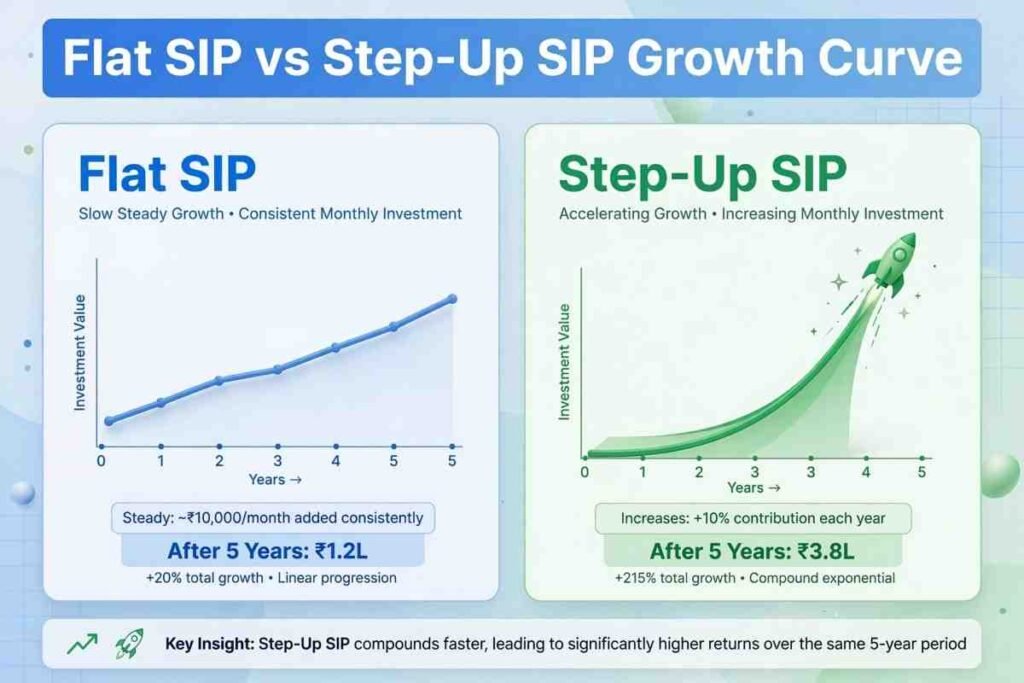
A standard Systematic Investment Plan commits a fixed rupee amount at recurring monthly intervals. While this enforces disciplined saving, it leaves significant wealth-building potential untapped as your disposable income increases.
Visual Comparison:
- Standard SIP (Flat Growth): Year 1 (₹10,000) ➔ Year 2 (₹10,000) ➔ Year 3 (₹10,000)
- Step-Up SIP (Accelerated compounding): Year 1 (₹10,000) ➔ Year 2 (₹11,000) ➔ Year 3 (₹12,100)
Dynamic SIP mechanics solve this by aligning your monthly investment contributions with your career trajectory:
- Percentage-Based Step-Up SIP: You commit to increasing your monthly investment by a fixed percentage (e.g., 10%) every 12 months. This naturally scales alongside annual corporate performance appraisals.
- Fixed-Amount Auto-Top-Up SIP: You instruct your fund house or investment portal to add a flat rupee amount (e.g., ₹2,000) to your monthly installment at designated intervals, such as every January or July.
Both methods prevent “lifestyle creep”—the tendency to spend extra income on non-essential expenses—by auto-routing pay raises directly into productive, wealth-generating assets before you ever spend them.
The Compound Interest Math Behind Step-Up Calculations
To understand why incremental top-ups dramatically shorten your investment horizon, we need to examine the mathematical framework behind dynamic compounding.
The standard future value formula for an ordinary monthly annuity is expressed as:
FV=P×[i(1+i)n−1]×(1+i)
Where:
- P = Fixed monthly SIP amount
- i = Periodic monthly interest rate (Annual Rate/12/100)
- n = Total number of monthly installments
The Step-Up Mathematical Equation
When you introduce a yearly percentage step-up rate (g), the investment stops behaving like a simple annuity. Instead, it becomes a series of growing annual annuities.
The future value of a percentage Step-Up SIP over Y years is calculated using the following summation model:
FVStepUp=y=1∑Y(P1×(1+g)y−1×[i(1+i)12−1]×(1+i)×(1+r)Y−y)
Where:
- P1 = Base monthly SIP amount in Year 1
- g = Annual step-up increment percentage
- Y = Total tenure in years
- i = Monthly compounding rate (Expected Annual Return/12/100)
- r = Annual compounding return rate (1+i)12−1
Because the principal installment (P) grows annually by (1+g)y−1, the compounding engine operates on a progressively larger capital base each year. This creates a dual-compounding effect, accelerating your progress toward your target corpus.
Scenario Analysis: Journey to ₹1 Crore

To evaluate how various SIP structures perform in practice, consider an investor starting with a base contribution of ₹10,000 per month and expecting an average market return of 12% per annum.
Let’s compare three distinct strategic paths:
- Option A: Fixed Monthly SIP (No Step-Up)
- Option B: Auto-Top-Up SIP (Fixed increase of ₹1,000 per month every year)
- Option C: Step-Up SIP (10% percentage increase every year)
15-Year Performance Comparison Table
| Metric | Option A: Fixed SIP (₹10k) | Option B: Top-Up SIP (+₹1k/yr) | Option C: Step-Up SIP (+10%/yr) |
|---|---|---|---|
| Base Monthly Principal | ₹10,000 | ₹10,000 | ₹10,000 |
| Annual Scaling Rule | None (0%) | +₹1,000 flat / year | +10% percentage / year |
| Total Principal Invested | ₹18,00,000 | ₹30,60,000 | ₹38,12,745 |
| Est. Wealth Generated | ₹32,45,760 | ₹36,98,903 | ₹43,02,488 |
| Total Corpus (Year 15) | ₹50,45,760 | ₹67,58,903 | ₹81,15,233 |
| Time to Reach ₹1 Crore | 18.7 Years | 15.2 Years | 13.8 Years |
Key Analytical Takeaways:
- Shaving 5 Years Off the Timeline: A 10% annual step-up allows you to reach the ₹1 Crore threshold in 13.8 years, compared to nearly 19 years with a flat SIP.
- Capital Efficiency: While Option C requires investing more overall principal (₹38.12 Lakhs vs. ₹18.00 Lakhs), these increased contributions occur later in your career, when your salary is naturally higher and easier to allocate.
- Beat Inflation: Flat SIPs gradually lose purchasing power over time due to inflation. A percentage-based step-up keeps your real investment capacity steady or growing ahead of inflation.
Step-Up SIP vs. Auto-Top-Up SIP: Which Method Should You Choose?

While both approaches outperform static investment plans, choosing between a percentage-based step-up and a fixed rupee top-up depends on your income structure and career stage.
Strategy Guide:
- Choose Percentage Step-Up SIP if you are a corporate professional with percentage-based annual appraisals, seeking long-term inflation defense and proportional scaling.
- Choose Fixed Rupee Top-Up SIP if you have predictable annual cash flows, fixed increments, or prefer conservative, nominal budgeting.
1. Percentage Step-Up SIP (Ideal for Corporate Professionals)
- Best Suited For: Early-to-mid-career corporate employees whose compensation scales through annual appraisal percentages.
- Primary Advantage: Automatically stays aligned with your earnings growth. An 8% pay raise easily accommodates a 10% step-up on your investment contributions.
- Potential Risk: In later years, as your base SIP grows large, a 10% increase represents a substantial absolute rupee jump. For example, a 10% increase on a ₹50,000 monthly SIP requires adding ₹5,000 per month in a single year.
2. Fixed Rupee Auto-Top-Up SIP (Ideal for Stable Cash-Flow Accounts)
- Best Suited For: Investors who prefer predictable budgeting or receive fixed nominal raises.
- Primary Advantage: Highly predictable cash flow requirements. You know in advance that your monthly contribution will increase by an exact amount (e.g., precisely ₹1,500 every April).
- Potential Risk: Fixed rupee top-ups can lag behind fast-growing salaries over time, making them slightly less effective at countering lifestyle inflation in high-growth careers.
Step-by-Step Implementation Guide
Setting up an automated step-up strategy requires minimal setup effort through modern investment platforms or fund houses.
Step 1: Establish Your Baseline Contribution
Calculate a comfortable starting monthly investment using a cash-flow analysis. Ensure your baseline contribution leaves enough room for essential living expenses and an emergency liquidity buffer.
Step 2: Match Step-Up Timing with Appraisal Cycles
Align your auto-step-up frequency with your annual compensation review. If your annual salary adjustment takes effect in April, schedule your SIP step-up for May to seamlessly capture the new income stream.
Step 3: Implement an Upper Cap (Optional)
Most Asset Management Companies (AMCs) and investment portals allow you to set a maximum monthly ceiling (e.g., capping the SIP once it reaches ₹50,000 per month). This feature prevents your automated contributions from exceeding your monthly budget during your peak earning years.
Step 4: Review and Adjust Periodically
While the process is fully automated, review your portfolio annually. If you experience an unusually large career jump or a period of reduced income, update your step-up instructions accordingly to reflect your new financial reality.
Conclusion
Building a ₹1 Crore investment portfolio isn’t just about picking high-performing equity funds—it’s about how effectively you scale your investment contributions over time.
Comparing a step up sip vs top up sip reveals a simple financial reality: keeping your monthly investments flat while your salary grows leaves significant compounding potential on the table. By leveraging the salary hike sip calculator formula and automating an annual 10% step-up, you can cut years off your wealth-building timeline and reach your financial goals far more efficiently.
What Is Your Wealth Strategy?
Are you currently using a flat SIP or an automated annual step-up? How do you manage annual pay raises alongside your long-term wealth targets? Share your experiences, thoughts, or questions in the comments below!