
Understand standard deduction rules for salaried employees in India and the USA. Learn limits, eligibility criteria, and tax-saving impacts for FY 2026-27.
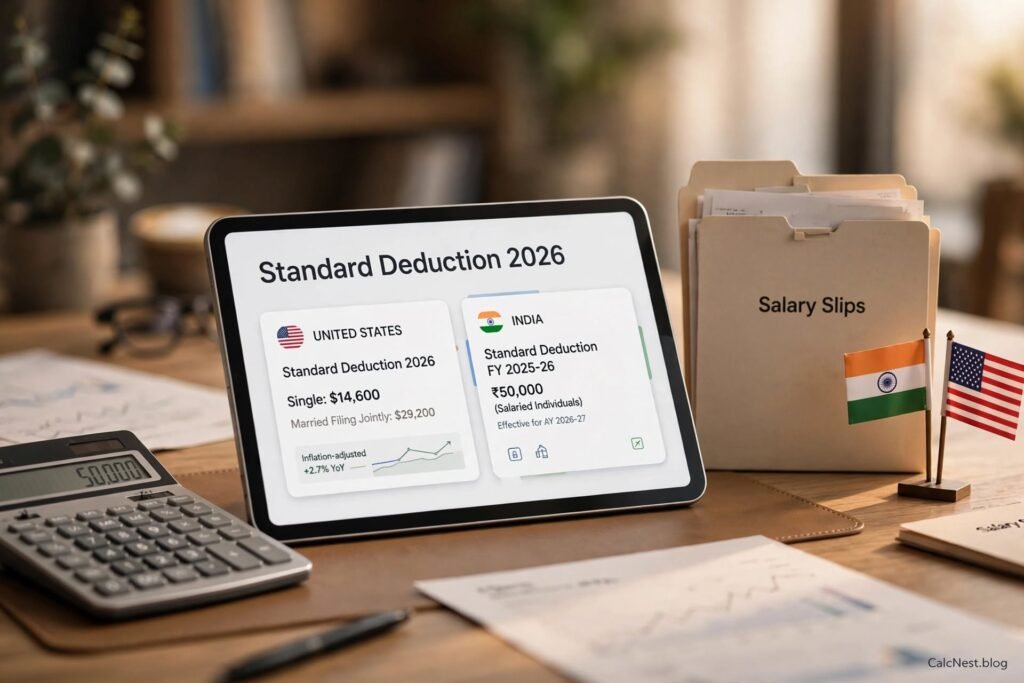
For salaried professionals, minimizing tax liability without maintaining heavy investment proofs is a major priority. One of the most effective provisions provided by tax authorities is the Standard Deduction—a flat exemption subtracted from your gross salary to lower your overall taxable income.
In this comprehensive guide, we explore the updated standard deduction rules, limits, and calculation mechanisms for salaried employees in India (FY 2026-27 / AY 2027-28) and the United States (Tax Year 2026).
Explore Financial Utility Tools: To instantly compute your net take-home salary after factoring in standard deductions and taxes, explore the financial calculators on CalcNest.
Part 1: Standard Deduction Rules for Salaried Employees in India (FY 2026-27)
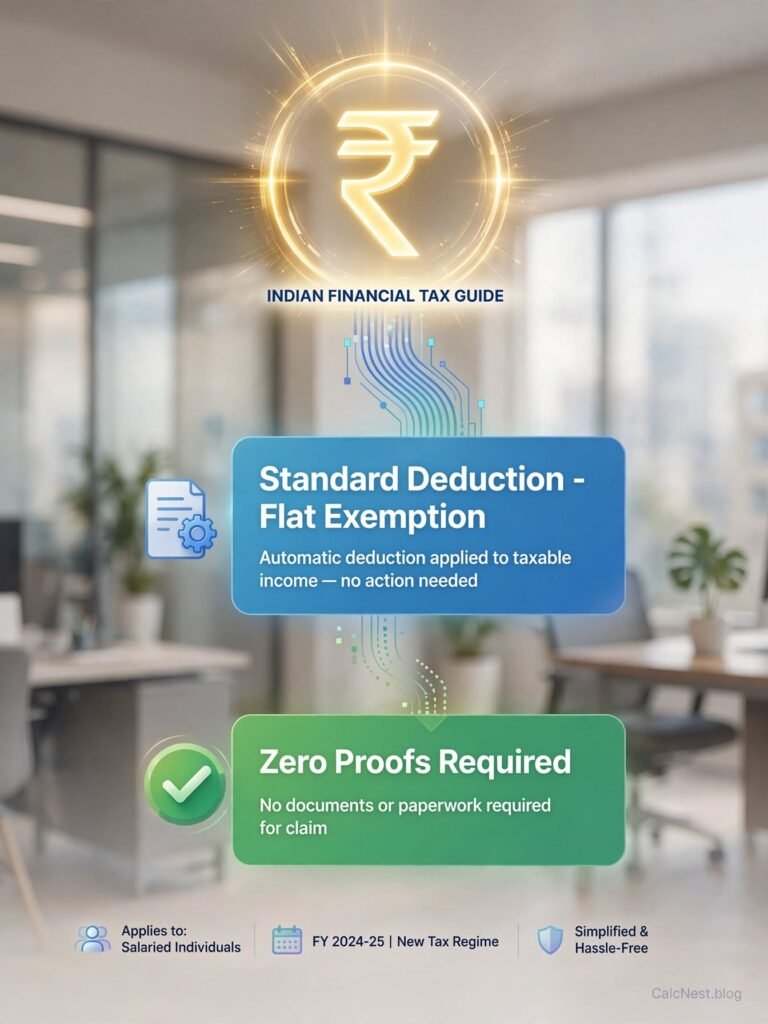
In India, the standard deduction is a flat amount directly subtracted from the salary income of employees, making tax filing simpler and reducing administrative friction.
1. Key Rules and Limits in India
- Applicability: Available to all salaried individuals and pensioners under both the New Tax Regime and the Old Tax Regime.
- Deduction Limit: The standard deduction limit is structured to provide substantial tax relief to middle-class and high-income earners, significantly lowering taxable salary.
- No Proof Required: Unlike HRA or Section 80C investments, employees do not need to submit rent receipts, investment bills, or expense proofs to claim this deduction; it is automatically applied by employers during TDS calculation.
For official updates and tax guidelines, refer to the Income Tax Department India.
Part 2: Standard Deduction Rules for Employees in the USA (Tax Year 2026)
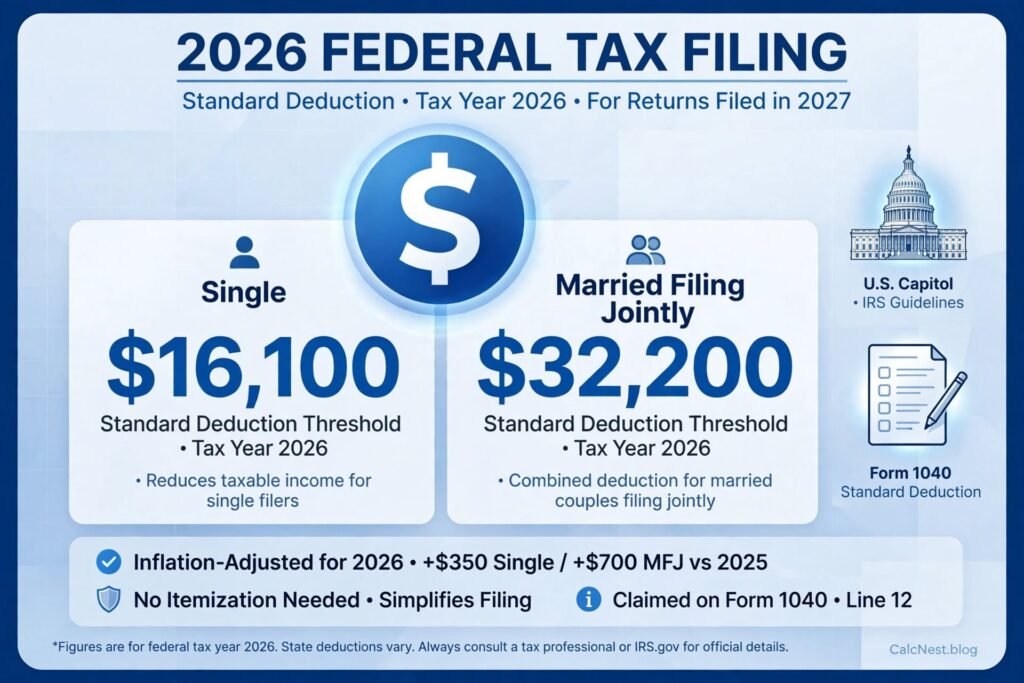
In the United States, the tax code provides a Standard Deduction which serves as a dollar-for-dollar reduction in your Adjusted Gross Income (AGI) before federal income tax is applied.
1. Key Rules and Limits in the US
- Filing Status Matters: The standard deduction amount varies significantly depending on your filing status—whether you file as Single, Married Filing Jointly, or Head of Household.
- Inflation Adjustments: To combat bracket creep, the Internal Revenue Service (IRS) adjusts standard deduction thresholds upward every year to account for inflation.
- Standard vs. Itemized: Taxpayers can choose between taking the standard deduction or itemizing specific deductible expenses (such as mortgage interest and charitable contributions), whichever yields a higher reduction.
For official tax brackets, forms, and updates, visit the Internal Revenue Service (IRS) USA.
Comparison Table: India vs. USA Standard Deduction Framework
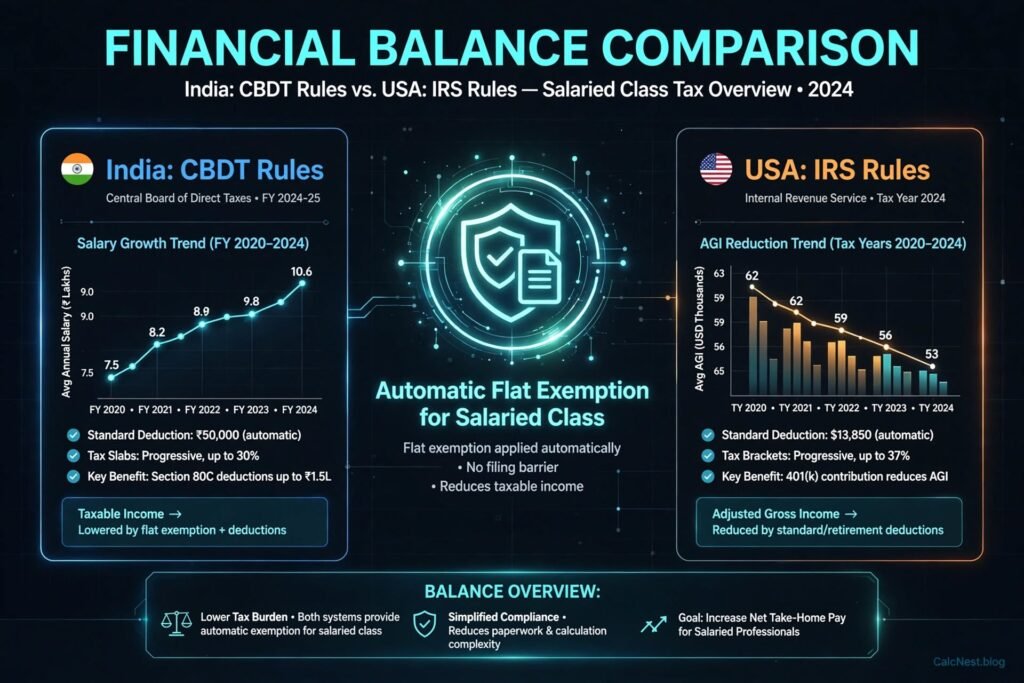
| Feature | India Standard Deduction Framework | USA Standard Deduction Framework |
| Tax Authority | Income Tax Department (CBDT) | Internal Revenue Service (IRS) |
| Eligibility | Salaried employees & pensioners | Individual taxpayers based on filing status |
| Proof Requirement | None (Flat automatic subtraction) | None (Alternative to itemizing deductions) |
| Primary Utility Tool | CalcNest | CalcNest |
Frequently Asked Questions (People Also Ask)
Q1. Do I need to submit bills to claim the standard deduction in India?
Ans: No. The standard deduction is a flat, automatic benefit for salaried employees, meaning no bills or investment proofs are required to claim it.
Q2. Can I take both the standard deduction and itemize deductions in the US?
Ans: Generally, no. Taxpayers must choose between taking the standard deduction or itemizing their deductions, depending on which option lowers their taxable income more.
Q3. Where can I calculate my net salary after standard deductions?
Ans: You can utilize free financial calculators and tax computation guides tailored for global users by visiting CalcNest.
Disclaimer
Disclaimer: This guide is intended strictly for educational and informational purposes. Tax laws, deduction limits, and government policies are subject to periodic updates. Always consult a certified Chartered Accountant (CA) in India or a Certified Public Accountant (CPA) in the United States before filing your tax returns.