
Confused between SIP and Lump Sum investment? Compare returns, risks, market timing, and rupee cost averaging to choose the best strategy for your financial goals.

When starting your mutual fund investment journey, one of the most common dilemmas is choosing between a Systematic Investment Plan (SIP) and a Lump Sum investment. Both methods have distinct advantages, risk profiles, and suit different financial situations and investor temperaments.
In this comprehensive guide, we break down the core differences, advantages, and ideal use cases for both SIP and Lump Sum investments to help you make an informed financial decision.
Explore Financial Utility Tools: To calculate your mutual fund returns, future wealth accumulation, or compound interest instantly, check out the smart financial calculators on CalcNest.
Part 1: What is a SIP (Systematic Investment Plan)?

A SIP allows you to invest a fixed amount of money in a mutual fund at regular intervals (weekly, monthly, or quarterly).
Key Features and Benefits of SIP
- Rupee Cost Averaging: Since you invest fixed amounts regularly, you automatically buy more units when the market is low and fewer units when the market is high, averaging out your purchase cost.
- Disciplined Investing: It inculcates a habit of regular savings without needing to time the market.
- Low Entry Barrier: You can start a SIP with a minimal amount (as low as ₹500 per month), making it ideal for salaried individuals and beginners.
Part 2: What is a Lump Sum Investment?
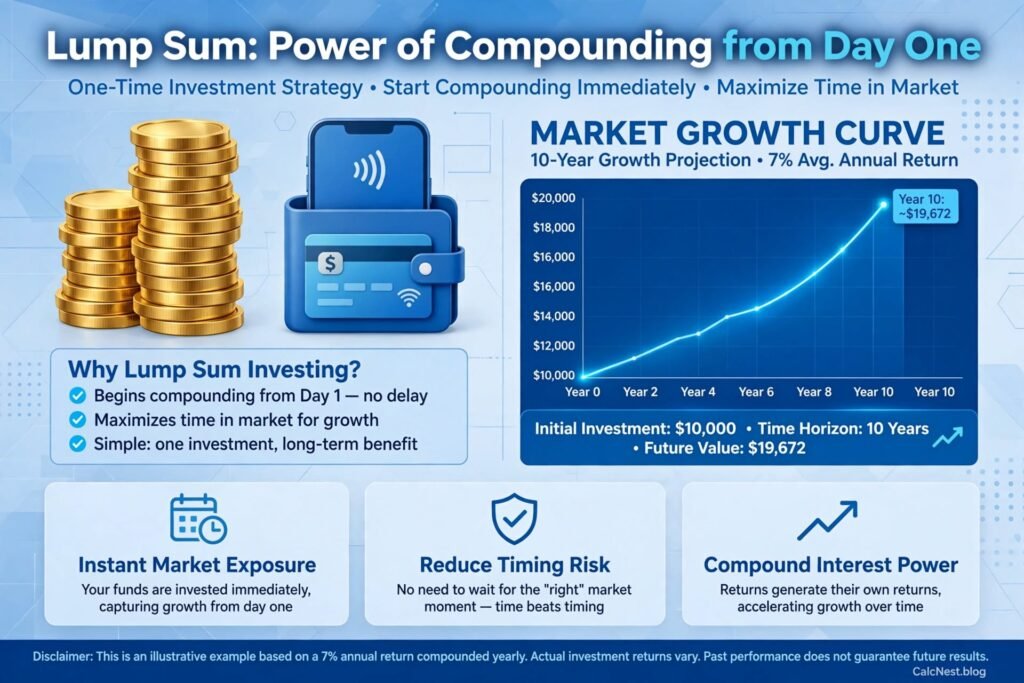
A Lump Sum investment involves investing a large, one-time amount into a mutual fund all at once (e.g., receiving a bonus, inheritance, or business profit).
Key Features and Benefits of Lump Sum
- Power of Compounding from Day One: Your entire capital starts working immediately, which can yield massive long-term gains if invested during a favorable market phase.
- Best for Bull Markets or Corrections: If invested during a major market crash or deep correction, lump sum investments can generate significantly higher returns compared to SIPs.
- Higher Initial Capital Requirement: It requires a substantial amount of ready cash, which may carry higher short-term risk if market volatility strikes immediately after investment.
Comparison Table: SIP vs. Lump Sum Investment

| Feature | Systematic Investment Plan (SIP) | Lump Sum Investment |
|---|---|---|
| Investment Style | Periodic fixed installments (Monthly/Weekly) | One-time single payment |
| Market Timing | Not required (Bypasses volatility) | Crucial (High risk if timed poorly) |
| Ideal For | Salaried employees & regular earners | Individuals with surplus cash / bonus |
| Risk Level | Lower (Due to rupee cost averaging) | Higher (Exposed to immediate market peaks) |
| Primary Utility Tool | CalcNest | CalcNest |
Frequently Asked Questions (People Also Ask)
Q1. Is SIP better than Lump Sum for long-term wealth creation?
Ans: SIP is generally preferred by retail investors because it removes emotional decision-making and protects against market volatility through rupee cost averaging. However, if you have a lump sum amount during a major market dip, deploying it all at once can sometimes outperform a staggered SIP.
Q2. Can I stop or pause my SIP anytime?
Ans: Yes, mutual fund SIPs are completely flexible. You can pause, stop, or increase your SIP amount at any time without any penalty in open-ended schemes.
Q3. Where can I calculate my expected SIP returns?
Ans: You can utilize free financial calculators and growth projection tools by visiting CalcNest.
Disclaimer
Disclaimer: This guide is intended strictly for educational and informational purposes. Mutual fund investments are subject to market risks; read all scheme-related documents carefully before investing. Always consult a certified financial advisor before making major investment decisions.