
Discover legal ways to save income tax in India and the USA. Learn smart investment deductions, tax-saving instruments, and compliance strategies for FY 2026-27.

Tax planning is an essential component of personal finance. Whether you are earning and filing taxes in India or navigating federal and state tax laws in the United States, utilizing legal deductions and tax-advantaged accounts can significantly reduce your tax liability and increase your net wealth.
In this comprehensive guide, we explore proven legal strategies, deductions, and tax-saving investment options for taxpayers in India (FY 2026-27) and the United States (Tax Year 2026).
Explore Financial Utility Tools: To compute your tax liabilities, deductions, or take-home salary instantly, check out the smart financial calculators on CalcNest.
Part 1: Legal Ways to Save Income Tax in India (FY 2026-27)
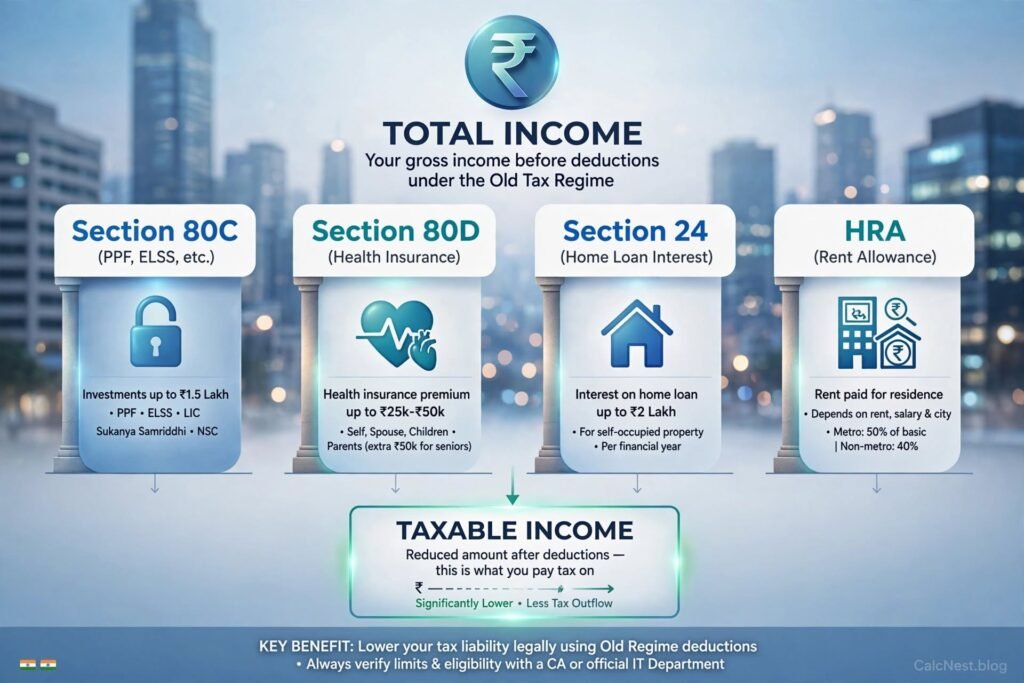
If you opt for the Old Tax Regime in India, the Income Tax Act provides multiple sections to claim deductions and lower your taxable income.
1. Key Deductions under Section 80C, 80D, and More
- Section 80C: Invest up to ₹1,50,000 annually in tax-saving instruments such as Public Provident Fund (PPF), Employee Provident Fund (EPF), Equity Linked Savings Scheme (ELSS) mutual funds, Life Insurance premiums, and National Savings Certificate (NSC).
- Section 80D (Health Insurance): Claim deductions on health insurance premiums paid for yourself, your family, and your parents (up to ₹25,000 for non-senior citizens and up to ₹50,000 for senior citizens).
- Section 24 (Home Loan Interest): Claim up to ₹2,00,000 on the interest paid towards a home loan for a self-occupied property.
- HRA (House Rent Allowance): Salaried individuals living in rented accommodations can claim HRA exemptions based on actual rent paid, salary structure, and city of residence.
For official updates and tax rules, visit the Income Tax Department India.
Part 2: Legal Ways to Save Income Tax in the USA (Tax Year 2026)
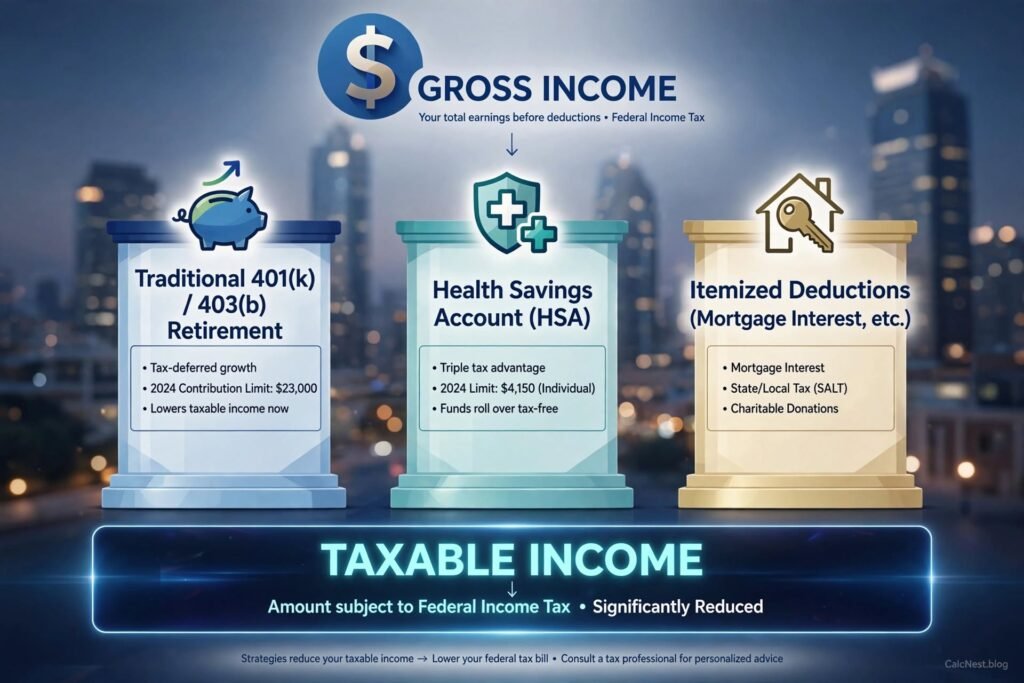
In the United States, tax minimization revolves around maximizing pre-tax retirement contributions and utilizing IRS-approved deductions.
1. Smart Tax-Saving Strategies in the US
- Maximize Retirement Accounts: Contribute to a traditional 401(k), 403(b), or Individual Retirement Account (IRA). Contributions to these pre-tax accounts directly lower your adjusted gross income (AGI) for the year.
- Health Savings Account (HSA): If enrolled in a High-Deductible Health Plan (HDHP), contributions to an HSA are 100% tax-deductible, grow tax-free, and can be withdrawn tax-free for qualified medical expenses.
- Standard vs. Itemized Deductions: Choose between taking the standard deduction or itemizing deductions if your total deductible expenses (such as mortgage interest, state and local taxes up to limits, and charitable donations) exceed the standard threshold.
For official guidance and IRS forms, visit the Internal Revenue Service (IRS) USA.
Comparison Table: Tax-Saving Approaches (India vs. USA)

| Feature | India Tax Saving Approach | USA Tax Saving Approach |
|---|---|---|
| Primary Focus | Investment-linked deductions (PPF, ELSS, 80C) | Pre-tax retirement accounts (401k, IRA) & HSA |
| Healthcare Savings | Section 80D (Health Insurance premiums) | Health Savings Accounts (HSA) & FSA |
| Housing Benefits | Home loan interest (Sec 24) & HRA exemptions | Mortgage interest deduction & property tax deductions |
| Primary Utility Tool | CalcNest | CalcNest |
Frequently Asked Questions (People Also Ask)
Q1. Which tax regime is better in India for saving tax?
Ans: If you have active investments and expenses under Section 80C, 80D, HRA, and home loan interest, the Old Tax Regime usually helps you save more. If you prefer low tax rates without maintaining investment proofs, the New Tax Regime is simpler.
Q2. How can I lower my Adjusted Gross Income (AGI) in the US?
Ans: You can lower your AGI by contributing to pre-tax retirement accounts like a traditional 401(k) or an IRA, and by making deductible contributions to a Health Savings Account (HSA).
Q3. Where can I calculate my estimated taxes and savings?
Ans: You can utilize free financial calculators and tax guides tailored for global users by visiting CalcNest.
Disclaimer
Disclaimer: This guide is intended strictly for educational and informational purposes. Tax laws, deduction limits, and government policies are subject to periodic changes. Always consult a qualified Chartered Accountant (CA) in India or a Certified Public Accountant (CPA) in the United States before making major financial decisions or filing returns.