

Meta Description: Discover how to calculate your exact age in years, months, days, hours, and minutes. Learn about leap years, historical calculations, and use our free CalcNest tool for instant precision.
When filling out official government paperwork, applying for jobs, registering for competitive exams, or simply celebrating a milestone birthday, knowing your precise age down to the exact day is essential. While most people instantly know their age in years, calculating the exact breakdown of years, months, and days can sometimes be surprisingly tricky. Months have varying lengths (ranging from 28 to 31 days), and leap years add an extra day every four years, disrupting standard mathematical divisions.
At CalcNest, we develop high-utility digital calculators designed to deliver precise results while providing top-tier, human-written content that helps secure approvals on platforms like Google AdSense. In this comprehensive guide, we will explore how age calculation works, the mathematical logic behind leap years, and answer the top Google “People Also Ask” questions.
Why Exact Age Calculation Matters
In many professional and legal contexts, approximate ages are simply not enough. Exact age calculations play a critical role in several areas of life:
- Employment and Eligibility Criteria: Many corporate positions, government services, and public sector exams enforce strict age limits down to a specific cutoff date.
- Legal and Financial Milestones: Opening certain investment accounts, claiming retirement benefits, or verifying legal majority status require exact birthdate validation.
- Astrological and Medical Records: Healthcare providers and astrological charts often rely on precise chronological age to track developmental milestones, pediatric growth, or biological baselines.
Relying on mental math or simple subtraction (e.g., Current Year minus Birth Year) often leads to errors because it ignores the specific months and days that have or have not yet elapsed in the current year.
The Mathematics Behind Age Calculation
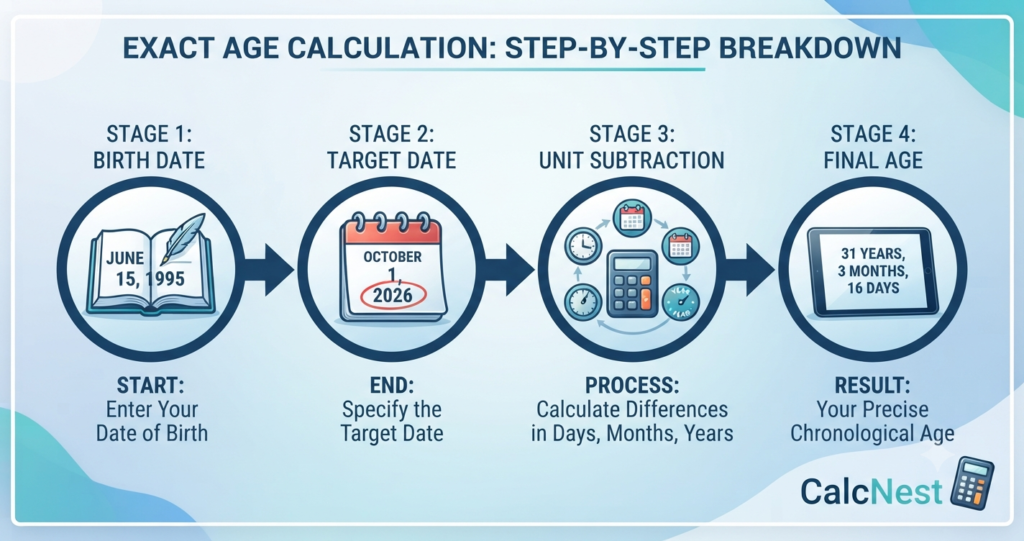
To calculate your exact age manually, you must break the calculation down into three sequential steps: Days, Months, and Years.
Step 1: Calculating the Days
Subtract your birth day from the current day. If the current day is smaller than your birth day, you must borrow days from the preceding month. The number of days borrowed depends entirely on the month prior to the current month:
- If borrowing from March, you add 28 or 29 days (depending on whether it is a leap year).
- If borrowing from months with 30 days (like April, June, September, November), you add 30 days.
- If borrowing from months with 31 days (like January, March, May, July, August, October, December), you add 31 days.
Step 2: Calculating the Months
Subtract your birth month from the current month. If the current month is earlier in the year than your birth month, you borrow 1 year (equivalent to 12 months) and add it to the current month count.
Step 3: Calculating the Years
Finally, subtract your birth year from the current year, accounting for any year borrowed during the month calculation.
Example Scenario:
- Birthdate: June 15, 1998
- Target Date: October 1, 2026
- Days: Current day is 1, birth day is 15. Since 1 < 15, borrow 1 month from September (30 days). $1 + 30 – 15 = 16$ days.
- Months: September became month 8. Birth month is June (6). $8 – 6 = 2$ months.
- Years: $2026 – 1998 = 28$ years.
- Exact Age: 28 years, 2 months, and 16 days.
To bypass manual calculations and avoid arithmetic errors, you can use our instant utility tool on the CalcNest Homepage.
Understanding Leap Years and Calendar Anomalies
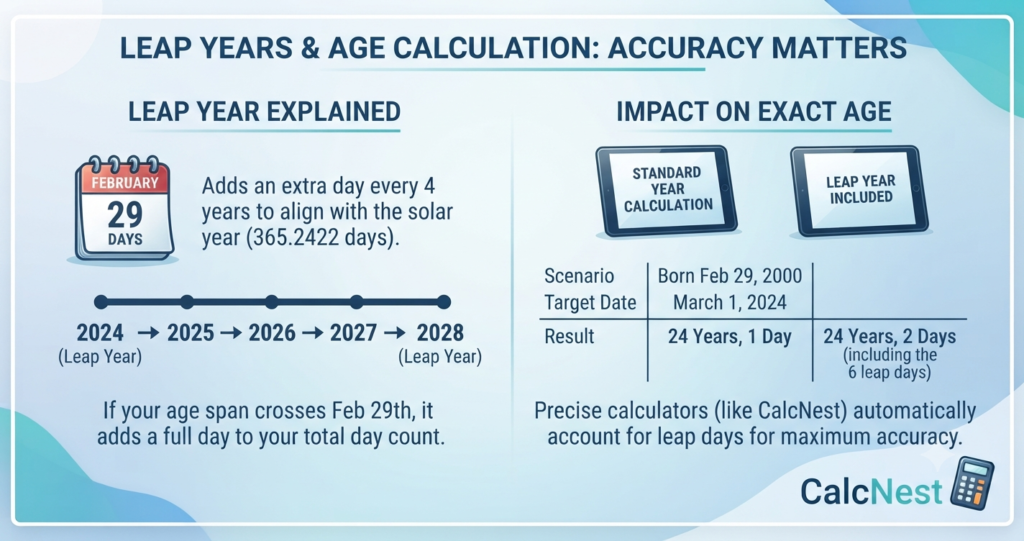
One of the greatest complications in age calculation is the leap year. Earth does not orbit the sun in exactly 365 days; it takes approximately 365.2422 days. To correct this discrepancy, our Gregorian calendar adds an extra day (February 29) every four years.
However, the rules are slightly more complex:
- Every year divisible by 4 is a leap year.
- Century exceptions: Years divisible by 100 are not leap years, unless they are also divisible by 400. For example, the year 2000 was a leap year, but 1900 was not.
If you were born on February 29 (a leap day), how old are you legally? In most jurisdictions, your legal birthday in non-leap years is recognized on either February 28 or March 1, depending on local legal precedents. Exact age calculators automatically factor in these intercalary days to ensure complete accuracy.
Comparison Table: Age Units Breakdown
| Time Unit | Calculation Multiplier / Basis | Practical Application |
| Years | 365.2425 days average per year | General milestones, legal age requirements, milestones. |
| Months | 12 months per year | Pediatric development, career tracking, loan tenures. |
| Weeks | 52 weeks per year (approx. 7 days each) | Pregnancy tracking, fitness programs, short-term planning. |
| Days | Exact calendar date differences | Government forms, exam cutoffs, precise legal filings. |
| Hours / Minutes | 24 hours/day, 60 minutes/hour | High-precision scientific, astrological, or birth records. |
Frequently Asked Questions (Google “People Also Ask”)
Q1: How do I calculate my exact age in days?
Ans: To find your total age in days, multiply your complete years lived by 365, add an extra day for every leap year you have lived through, and then add the remaining days from your current incomplete year. Automated tools like CalcNest compute this instantly.
Q2: Why do age calculators give slightly different results during leap years?
Ans: Leap years add an extra 24-hour period into the calendar cycle. If a time span crosses February 29, the calculator incorporates that 366th day into the total day count, shifting day-level outputs by +1 compared to standard years.
Q3: Is age calculated differently in different cultures?
Ans: Yes! While Western countries calculate age based on elapsed time from birth (turning 1 on your first birthday), traditional East Asian age reckoning (such as the traditional Korean age system) historically considered a person to be 1 year old at birth, with everyone aging up together on New Year’s Day. However, modern legal and official systems globally now rely on the standard international solar calendar.
Q4: Can an exact age calculator determine the day of the week I was born?
Ans: Many advanced age calculators use underlying Julian and Gregorian calendar algorithms to determine not only your exact age breakdown but also the exact day of the week (e.g., Monday, Tuesday) your birth date fell on.
Conclusion
Calculating your exact age in years, months, and days is no longer a matter of manual guesswork or tedious calendar counting. Whether you are preparing official documentation, tracking personal milestones, or satisfying your own curiosity, precision matters.
Explore our suite of fast, reliable, and ad-free calculation tools today at CalcNest to get instant, accurate results every single time!
Disclaimer
Disclaimer: The content provided in this article is for informational and educational purposes only. While CalcNest strives for absolute mathematical accuracy, users should verify official age requirements with relevant governing bodies, institutions, or legal authorities before submitting official paperwork.