
Meta Description: Master the percentage increase and decrease formula with step-by-step examples for USA and India markets. Learn how to calculate growth, drops, and discounts easily with CalcNest.
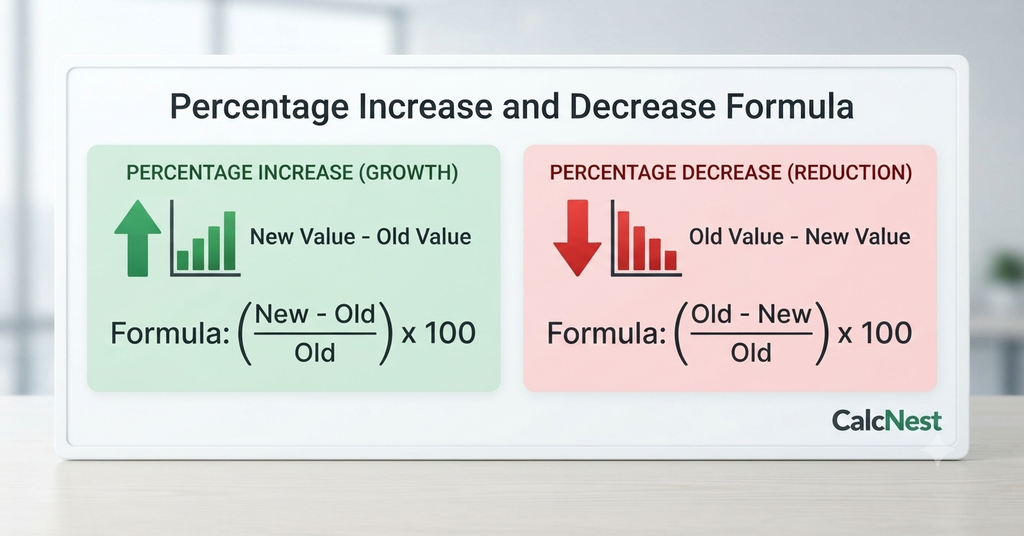
Understanding how to calculate percentage growth or decline is an essential life skill. Whether you are analyzing financial stock markets or retail sales in the United States, or tracking academic grades, inflation, and salary hikes during a festive season in India, the percentage increase and decrease formula is used everywhere.
At CalcNest, our goal is to simplify math and utility calculations for a global audience spanning the United States, India, and international regions. In this comprehensive guide, you will learn the exact formulas, step-by-step calculation methods, real-world examples, and answers to the top Google “People Also Ask” questions to help you master percentage changes completely.
What is Percentage Change and Why Does Context Matter?
Percentage change measures how much a quantity has grown (increased) or shrunk (decreased) relative to its original starting amount. It is always expressed as a percentage (%).
- Percentage Increase: Occurs when the new value is greater than the original value.
- Percentage Decrease: Occurs when the new value is smaller than the original value.
Depending on whether you are managing business metrics in New York or calculating financial savings in Mumbai, applying the correct baseline is critical for accurate financial and data analysis. To check quick mathematical evaluations, you can use our free tools available on the CalcNest Homepage.
1. The Percentage Increase Formula
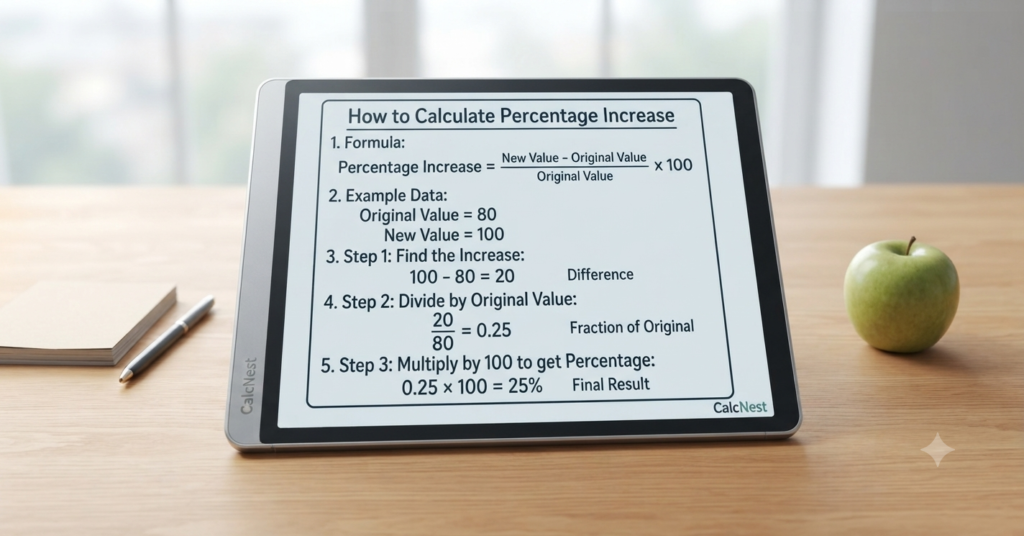
To find out how much a value has grown, use the standard percentage increase formula:
$$\text{Percentage Increase} = \left( \frac{\text{New Value} – \text{Original Value}}{\text{Original Value}} \right) \times 100$$
Step-by-Step Guide to Calculate Percentage Increase:
- Find the Difference: Subtract the original (old) value from the new value ($\text{New Value} – \text{Original Value}$).
- Divide by the Original Value: Divide that difference by the original starting number.
- Multiply by 100: Multiply the outcome by 100 to convert it into a percentage.
Real-World Example (USA Market Context):
Imagine a retail product’s price in a US store increases from $50 to $60.
- Step 1: $60 – 50 = 10$ (Increase amount)
- Step 2: $10 \div 50 = 0.2$
- Step 3: $0.2 \times 100 = 20\%$
- Result: A 20% increase in price.
Real-World Example (India Market Context):
Suppose an employee’s monthly salary in an Indian corporate firm goes up from ₹40,000 to ₹48,000.
- Step 1: $48,000 – 40,000 = ₹8,000$ (Hike amount)
- Step 2: $8,000 \div 40,000 = 0.2$
- Step 3: $0.2 \times 100 = 20\%$
- Result: A 20% salary hike.
To explore more financial and mathematical tools, check out our utility suite at CalcNest All Calculators.

2. The Percentage Decrease Formula
To calculate the reduction or drop between an initial value and a final value, use the percentage decrease formula:
$$\text{Percentage Decrease} = \left( \frac{\text{Original Value} – \text{New Value}}{\text{Original Value}} \right) \times 100$$
Step-by-Step Guide to Calculate Percentage Decrease:
- Find the Difference: Subtract the new value from the original (old) value ($\text{Original Value} – \text{New Value}$).
- Divide by the Original Value: Divide the drop amount by the original base number.
- Multiply by 100: Multiply the result by 100 to get the percentage value.
Real-World Example (Shopping & Discounts):
You want to buy a winter jacket marked down from $80 to $60 during an end-of-season clearance sale.
- Step 1: $80 – 60 = 20$ (Discount amount)
- Step 2: $20 \div 80 = 0.25$
- Step 3: $0.25 \times 100 = 25\%$
- Result: A 25% discount (percentage decrease).
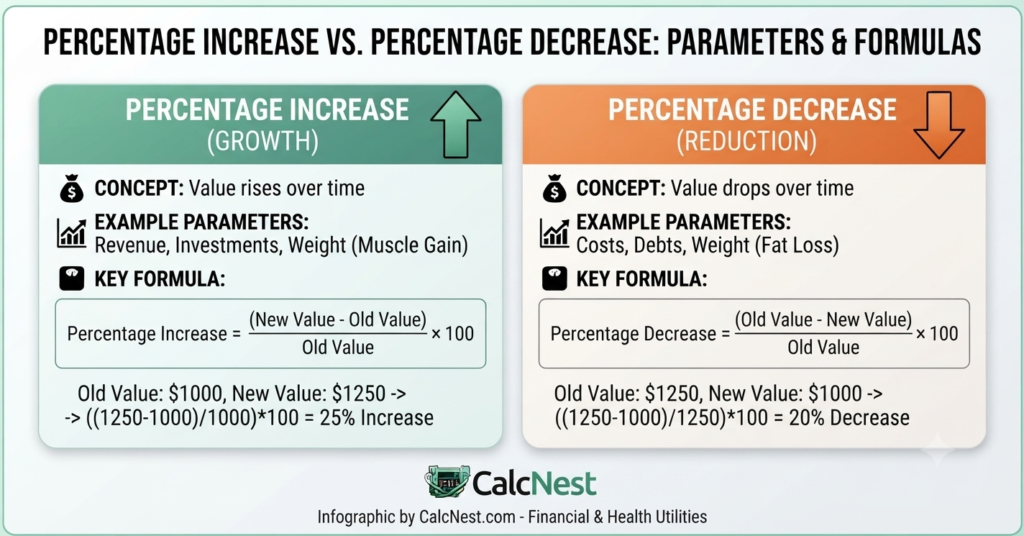
Comparison Table: Percentage Increase vs. Percentage Decrease
| Parameter | Percentage Increase | Percentage Decrease |
| Condition | New Value > Original Value | New Value < Original Value |
| Numerator Calculation | $\text{New Value} – \text{Original Value}$ | $\text{Original Value} – \text{New Value}$ |
| Base Denominator | Original Value | Original Value |
| Common Use Cases | Salary hikes, inflation tracking, stock price growth | Discounts, markdowns, weight loss tracking, depreciation |
Frequently Asked Questions (Google “People Also Ask”)
Q1: What is the formula for percentage increase?
Ans: The formula is:
$$\text{Percentage Increase} = \left( \frac{\text{New Value} – \text{Original Value}}{\text{Original Value}} \right) \times 100$$
It measures how much a value has grown relative to its starting base.
Q2: How do you find the new value after a percentage increase?
Ans: To find the new value when you know the percentage increase, multiply the original value by $(1 + \text{percentage} \div 100)$. For example, a 25% increase on 400 is calculated as $400 \times 1.25 = 500$.
Q3: Why can’t you just subtract percentages directly?
Ans: Percentages are relative values, not absolute values. If a company’s market share grows from 10% to 15%, the absolute difference is 5 percentage points, but the actual relative percentage increase is $(15 – 10) \div 10 \times 100 = 50\%$.
Q4: Is percentage change the same as percentage difference?
Ans: Not quite. Percentage change compares an old value to a new value (where direction—increase or decrease—matters). Percentage difference compares two independent numbers where there is no clear “original” or “new” value.
Disclaimer
Disclaimer: The information provided in this article and on CalcNest is for general educational and informational purposes only. While we ensure mathematical accuracy, users should verify critical financial or business calculations independently before making official decisions.