
A close friend of mine spent nearly fifteen years putting away every spare rupee into his pension fund. He was meticulous about it. Then, late last year, his father needed unexpected emergency heart surgery. Within three weeks, half of his long-term savings vanished to clear hospital bills.
Stories like this happen every day across India. Medical bills are easily the biggest threat to anyone trying to build long-term wealth.
For a long time, the Pension Fund Regulatory and Development Authority (PFRDA) locked retirement money up tight. Their logic was simple: don’t touch the corpus so it can compound over time. But life doesn’t care about compounding periods, and health crises don’t wait until you hit 60.
To bridge this gap, PFRDA launched the NPS Swasthya pension scheme. It’s a hybrid setup designed to keep your core pension growing in the market while giving you immediate access to cash and medical cover when a health crisis hits.
Here is a straightforward look at how the NPS Swasthya rules work, how an NPS health emergency withdrawal operates, and whether it deserves a spot in your financial plan.
What Is the NPS Swasthya Pension Scheme?
Think of the NPS Swasthya pension scheme as a single account split into two clear jobs:
- The Growth Side: Your main investment stays in market-backed assets under standard government guidelines, building up your retirement pot.
- The Safety Net: A mandatory super top-up health insurance policy tied directly to your account, managed alongside partner insurance providers.
Instead of scrambling for high-interest personal loans or liquidating long-term investments during a medical scare, this structure handles the financial strain upfront.
How It Works in Practice
1. Mandatory Super Top-Up Cover
Opening an NPS Swasthya account means picking a super top-up policy. It operates as a family floater, covering you, your spouse, and up to two kids under one umbrella.
PFRDA offers four simple coverage tiers based on your needs:
| Deductible | Total Coverage | Who It Fits Best |
| ₹10,000 | ₹1 Lakh | Minor medical care and routine outpatient visits |
| ₹50,000 | ₹5 Lakh | Younger workers with basic office health plans |
| ₹1,00,000 | ₹10 Lakh | Mid-career professionals wanting a stronger cushion |
| ₹3,00,000 | ₹30 Lakh | Families looking for maximum medical protection |
2. Fees and Account Costs
Starting out won’t strain your wallet. Here’s what it costs:
- First Deposit: A minimum of ₹1,000 to open the investment account.
- Annual Admin Fee: ₹200 (+ GST) to the Health Benefit Administrator.
- Insurance Premium: Varies based on the cover tier you choose.
- Ongoing Contributions: Add as little as ₹10 whenever you want.
- Fund Management Fee: Capped at just 0.08% per year of your total account balance.
How the Health Emergency Withdrawals Work

Getting money out of traditional pension accounts used to be a nightmare. NPS Swasthya changes that completely with flexible withdrawal mechanics.
The Breakdown:
- The 25% Limit: Under the updated NPS Swasthya rules, you can process an NPS health emergency withdrawal of up to 25% of the money you directly deposited into the account.
- No Waiting Period: Standard NPS accounts make you wait 3 years before taking partial withdrawals. NPS Swasthya has zero waiting time. If you sign up today and get sick next month, the funds are accessible right away.
- Multiple Claims Allowed: You aren’t limited to a single claim, provided your overall withdrawals stay under the 25% ceiling.
- Direct Hospital Settlement: Money does not go to your personal bank account. PFRDA sends payments directly to the hospital or clinic. This speeds up processing and eliminates fraudulent claims.
- Full Exit Option: If a massive health bill exceeds your 25% limit, you can request an emergency full exit from your Swasthya account to clear the hospital bill directly.
Curious how leaving your main investments untouched aids compounding? Run a quick scenario on our free SIP Calculator.
Standard NPS Tier-1 vs. NPS Swasthya
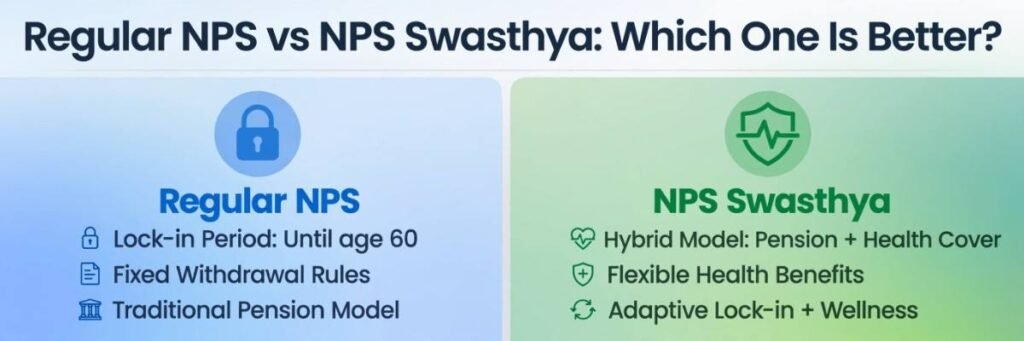
| Feature | Regular NPS Tier-1 | NPS Swasthya Hybrid |
| Primary Focus | Retirement savings only | Pension growth + Emergency health liquidity |
| Lock-in Period | 3-year mandatory wait | No lock-in for health emergencies |
| Withdrawal Cap | 25% (limited to specific critical illnesses) | 25% (covers hospital stays and OPD bills) |
| Payment Route | Sent to your bank account | Direct cashless transfer to hospital |
| Health Insurance | None | Super Top-Up cover up to ₹30 Lakh |
| Age Limits | Entry: 18–70 years | Entry: 18–70 (Renewable up to Age 85) |
If you plan to increase your savings as your income grows, use our Step-up SIP Calculator to project your targets.
Tax Breakdown & Smart Planning
Navigating taxes with the NPS Swasthya pension scheme is fairly straightforward:
1. Tax Deductions
Deposits into the investment side qualify for tax breaks under Section 80CCD(1) and the extra ₹50,000 limit under Section 80CCD(1B). The insurance premium portion gives you additional deductions under Section 80D.
2. Tax-Free Emergency Withdrawals
Because emergency payouts go straight to the medical provider, they aren’t treated as personal income. You won’t owe any tax on emergency funds used for treatment.
3. Policy Renewal Alert
Keep enough buffer cash in your account to cover the yearly health insurance renewal. PFRDA sends alerts at 90, 60, and 30 days before the due date. If your balance runs empty, your medical cover could lapse.
Final Takeaway: Should You Open One?

The NPS Swasthya pension scheme is a smart, practical choice if you want to protect your long-term wealth while keeping a safety net for sudden medical costs.
- Salaried Employees: If your employer health cover is under ₹5 lakh, adding an NPS Swasthya ₹30 lakh top-up gives you massive protection at a fraction of the cost.
- Self-Employed & Freelancers: If you don’t have corporate health perks, this merges health protection and pension building into a single system.
To check your current tax slab and calculate your net take-home pay, try our Income Tax Calculator and Salary Calculator.