
Understand the key differences between Simple Interest (SI) and Compound Interest (CI). Learn formulas, step-by-step examples, and when to use each for your financial planning.

When dealing with savings, loans, or investments, the two fundamental concepts you will encounter are Simple Interest and Compound Interest. Understanding the difference between them is essential whether you are trying to grow your wealth through investments or minimize borrowing costs on a loan.
In this comprehensive guide, we will break down how both interest types work, provide clear mathematical formulas, and compare their long-term impact.

1. What is Simple Interest (SI)?
Simple Interest is calculated exclusively on the original principal amount borrowed or invested for the entire duration of the loan or investment period. This means the amount of interest earned or paid remains constant every single year.
Simple Interest Formula:
$$\text{SI} = \frac{P \times R \times T}{100}$$
Where:
- P = Principal amount (Initial investment or loan)
- R = Annual interest rate (in percentage)
- T = Time period (in years)
Example of Simple Interest:
Suppose you invest $10,000 at an annual interest rate of 5% for 3 years:
- $\text{SI} = \frac{10000 \times 5 \times 3}{100} = \$1,500$
- Total Amount (Principal + Interest) = $\$10,000 + \$1,500 = \$11,500$
Quick Financial & Utility Tools: To explore smart digital tools, percentage calculators, and financial planners, visit our platform at CalcNest.
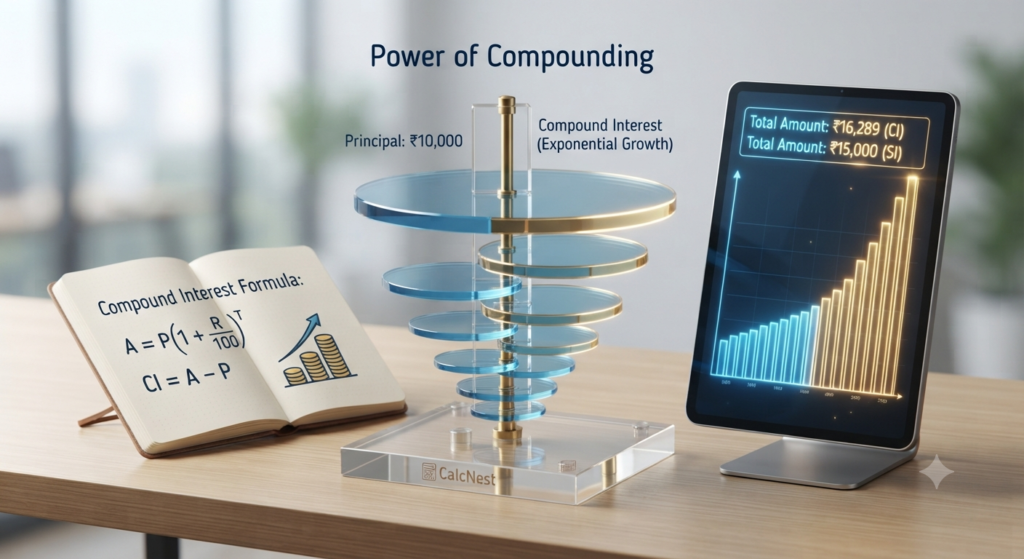
2. What is Compound Interest (CI)?
Compound Interest (often referred to as “interest on interest”) is calculated on the initial principal plus all the accumulated interest from previous periods. Because the base amount grows every period, your money grows exponentially over time.
Compound Interest Formula:
$$\text{Total Amount (A)} = P \left(1 + \frac{R}{100}\right)^T$$
$$\text{Compound Interest (CI)} = A – P$$
Example of Compound Interest:
If you invest that same $10,000 at 5% annual compound interest for 3 years:
- $A = 10000 \left(1 + \frac{5}{100}\right)^3 = 10000 \times (1.05)^3 = \$11,576.25$
- $\text{CI} = 11,576.25 – 10,000 = \$1,576.25$
As you can see, compound interest yields an extra $76.25 compared to simple interest over the same timeframe! For official banking standards and monetary policies, you can refer to regulatory institutions like the Federal Reserve in the US or the Reserve Bank of India (RBI) in India.

Comparison Table: Simple Interest vs. Compound Interest
| Feature | Simple Interest (SI) | Compound Interest (CI) |
| Calculation Basis | Calculated only on the original principal amount. | Calculated on principal plus accumulated interest. |
| Growth Trajectory | Linear and slow growth over time. | Exponential and fast growth over time. |
| Interest Yield | Remains constant every single year. | Increases progressively with each compounding cycle. |
| Commonly Used In | Short-term loans, vehicle loans, simple deposits. | Long-term investments, mutual funds, retirement accounts, mortgages. |
To calculate complex interest rates and financial figures instantly without manual errors, try our dedicated financial calculators at CalcNest.

Frequently Asked Questions (People Also Ask)
Q1. Which is better for long-term wealth building?
Ans: Compound Interest is significantly better for investments. Albert Einstein famously called compound interest the “eighth wonder of the world” because of how aggressively it multiplies wealth over long horizons.
Q2. Do modern banks use simple or compound interest for loans?
Ans: Most retail loans (such as mortgages, auto loans, personal loans, and credit cards) utilize compound interest, compounding either monthly, quarterly, or daily.
Q3. Where can I calculate compound interest automatically?
Ans: You can bypass manual computations by utilizing digital calculators. Explore the interactive financial tools available at CalcNest.
Disclaimer
Disclaimer: The information provided in this article is for general educational and informational purposes only and does not constitute professional financial or investment advice. Always evaluate terms and consult a certified financial advisor before making major financial commitments.