
Ever stood in a crowded retail store aisle or stared blankly at an online checkout screen, looking at a confusing sign that reads “30% off clearance plus local tax applied at final billing”, and thought to yourself—wait, how much am I actually going to pay when my card gets swiped?

Let’s be completely honest. Modern shopping is a psychological puzzle. Retailers love dangling massive percentage-off banners in front of us, but when you add fluctuating sales tax rates into the mix, the final number at the register can come as an unpleasant shock. That is precisely why utilizing a smart sales tax and discount calculator completely changes how you manage your money.
In this comprehensive guide, we are going to break down how retail markdowns and state or local taxes intersect, why manual calculations fail us under pressure, and how you can use digital tools to master your spending.
Why Retailers and Taxes Create a Confusing Math Trap

Shopping is supposed to be an exciting experience. Whether you are hunting for holiday gifts, updating your seasonal wardrobe, or buying expensive tech gear during a flash sale, scoring a bargain feels like a win. However, modern retail marketing combined with regional tax policies creates a chaotic environment.
When you stand under bright store lights, your cognitive load spikes. Your brain tries to calculate 20% off a $47.50 shirt while simultaneously factoring in local sales tax. Suddenly, you stop calculating and just trust the big red sign.
This is a dangerous trap. Not all sales are created equal. Knowing how to evaluate prices and taxes independently ensures you stay in complete control of your budget. For consumer protection insights regarding fair pricing and retail disclosures, you can review consumer rights through the Federal Trade Commission (FTC).
The Core Mathematics: How Discounts and Sales Tax Interact
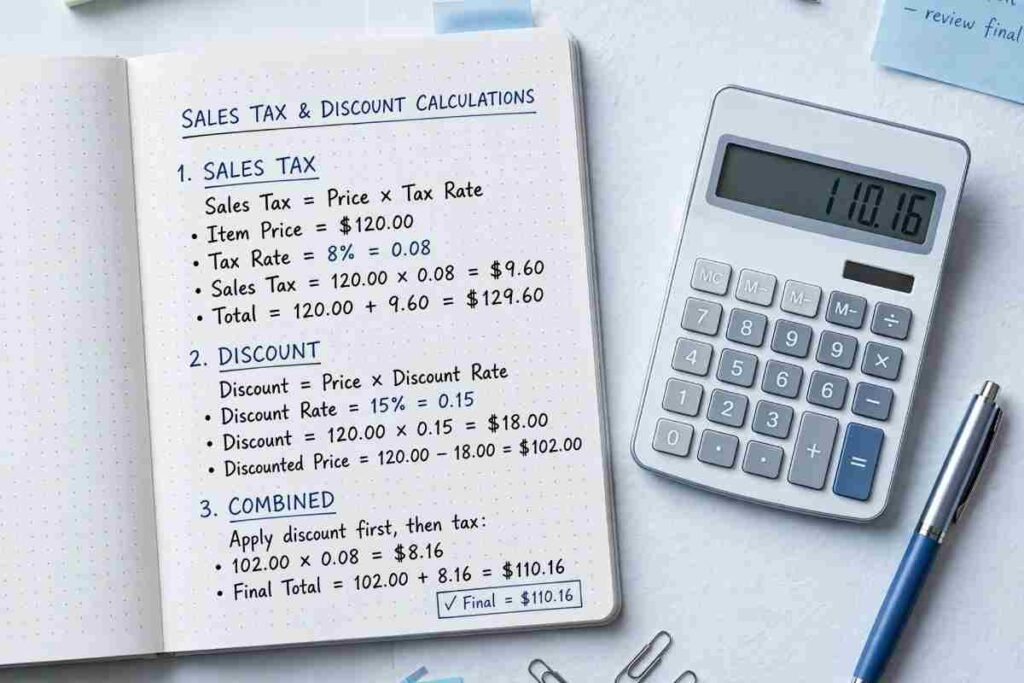
If you want to understand the raw mechanics behind your receipts, or if your phone battery dies while you are browsing in a physical shopping mall, knowing how to calculate markdowns and taxes by hand is an essential skill.
Step 1: Apply the Percentage Discount First
The golden rule of retail math is that discounts are almost always calculated before sales tax is applied.
- Convert your discount percentage into a decimal (e.g., $20\% = 0.20$).
- Multiply that decimal by the original price to find your total cash savings.
- Subtract the savings from the original price to get your discounted subtotal.
Step 2: Add the Sales Tax to the Subtotal
Once you have your discounted subtotal, you calculate the local sales tax based on that reduced amount—giving you a quiet double-saving, because your tax burden drops right along with the item’s price.
- Convert your local tax rate into a decimal (e.g., $8\% = 0.08$ or a regional GST rate of $18\% = 0.18$).
- Multiply the subtotal by the tax rate to find the tax amount.
- Add that tax amount to your subtotal to arrive at your final checkout total.
Comparison: Manual Calculation vs. Using an Online Tool
To see why relying on digital tools saves you time and mental energy, let’s look at how manual calculations compare to using an automated utility.
| Feature / Factor | Manual Calculation (Pen & Paper) | Online Sales Tax & Discount Calculator |
| Speed & Efficiency | Slow; prone to errors with multi-item carts. | Instantaneous results in milliseconds. |
| Tax Integration | Complex; requires separate multi-step formulas. | Automated calculation based on subtotal. |
| Accuracy | High risk of rounding or decimal placement mistakes. | 100% precise down to the exact cent or paisa. |
| Convenience | Impractical during fast-paced online flash sales. | Accessible instantly on your smartphone or PC. |
To skip the mental strain and get instant, precise breakdowns for all your retail purchases, you can easily use the free retail and financial utilities available right over at CalcNest.
Common Shopping Mistakes That Cost You Money
Before we wrap up, let us look at three common financial traps people fall into during major shopping events:
- Ignoring Tax Inclusion Rules: In many regions, listed prices exclude tax, meaning your cart total will always be higher than expected at checkout. Always account for regional tax variations.
- Falling for Stacked Coupon Myths: If a store gives you a 20% coupon and then an extra 10% member discount, they usually do not add up to 30%. The second discount applies to the already reduced subtotal.
- Buying Just to Reach Free Shipping Thresholds: Spending an extra $30 on items you do not need just to save $7 on shipping defeats the whole purpose of saving money.
Frequently Asked Questions (FAQ)
Q1. Do stores apply discounts before or after sales tax?
Yes, retailers almost universally apply percentage discounts to the original price before calculating local sales taxes. This means you save money twice: a lower item price, followed by a lower total tax charge.
Q2. Are online tax and discount calculators free to use?
Yes! Most web-based calculation tools—including the smart financial utilities hosted on CalcNest—are completely free, lightweight, and designed to give you instant results without any friction or annoying paywalls.
Q3. How can I calculate a quick discount in my head?
To find 20% off fast, first find 10% of the price by moving the decimal point one digit to the left (for a $50 item, 10% is $5). Then, double that number ($5 \times 2 =$10). Subtract that $10 from the original price to get your sale price ($40).
Final Thoughts: Shop Smarter, Not Harder
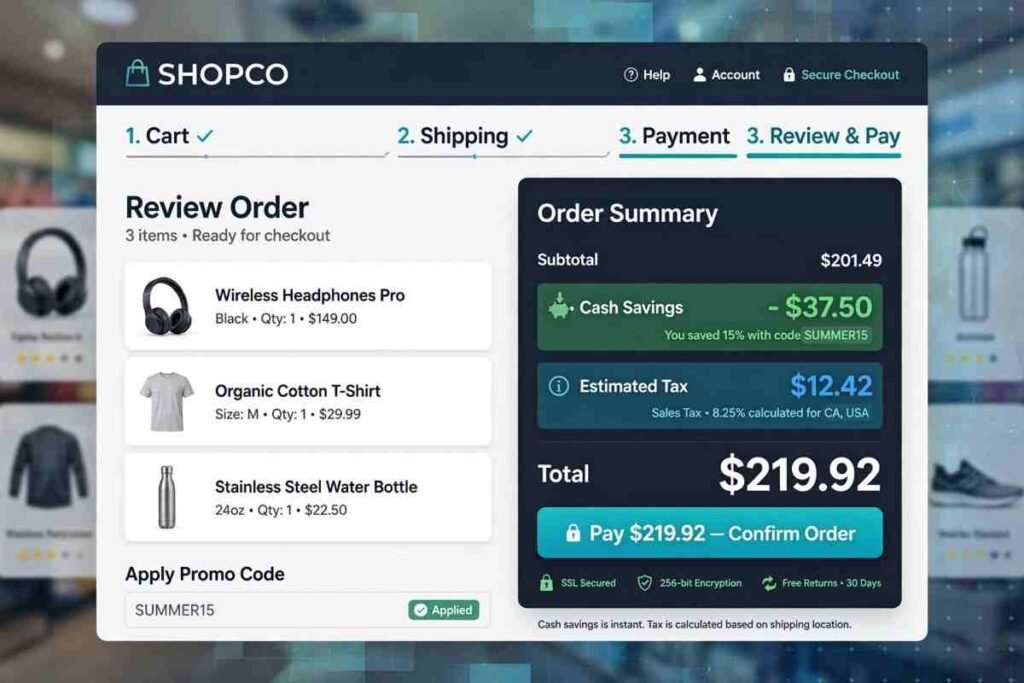
Shopping smart is never about pinching every single penny until it hurts—it is about understanding the true value of your hard-earned money. By keeping a handy sales tax and discount calculator in your digital toolkit, you can navigate holiday sales events, clear out online shopping carts with confidence, and protect your monthly budget effortlessly.
Head over to CalcNest today to explore more lightning-fast financial calculators designed to make your everyday numbers a complete breeze!
Disclaimer
Disclaimer: The information provided in this guide and on CalcNest is strictly for educational, informational, and general utility purposes only. Retail pricing structures, promotional discount rules, store clearance policies, and local sales tax laws vary significantly depending on your geographic region and individual merchants. Always verify final checkout prices, taxes, and terms directly with the retailer before completing any purchase. CalcNest assumes no financial liability for any calculation discrepancies or purchasing decisions made based on this content.